
Touching others with gifts
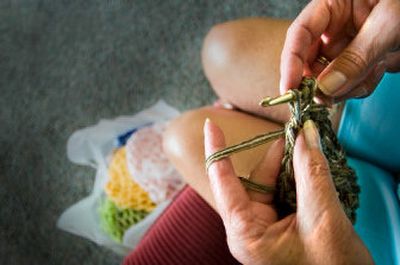
When Georgene Kaplan-Swift showed the owner of a South Hill yarn store her bag of crocheted hats that she makes for women with cancer, Mary Lindeblad cried.
“I thought it was really touching. I was so overwhelmed with her generosity; I just get touched by people who work hard to help other people,” said Lindeblad, owner of A Grand Yarn.
But for Kaplan-Swift, crocheting hundreds of colorful hats for female cancer patients is therapy.
The Rosalia,Wash., resident has seen a grandfather, father, sister, husband and daughter all lose exhausting battles to cancer. So making hats is not generosity; it’s a gift she gives to cancer patients that she couldn’t give to her family.
“It was a very hard time,” she said, “so you do your crying outside, but then you are strong when you are with them.”
She is a tough 69-year-old who claims she is “kicking 70 in the rear” but has a soft spot for those who undergo chemotherapy during cancer.
“It’s a rough time,” Kaplan-Swift said. She remembers when her daughter’s hair fell out, and she got sick so often that she carried a bucket around the house.
“She called it her puke bucket,” she whispered. Making hats wasn’t an option for her. She just “pulled her boot straps up” and took care of her ailing family.
Her daughter and husband died in 1993, three months apart from each another.
Today, Kaplan-Swift beams as she holds up a frilly baby blue skull hat with a lace ribbon weaved in the bottom edge. This is the 700th hat she made.
“I wanted to finish before you came,” she told a visitor. When she finishes about 20 hats, she carries them in an old plastic bag to various cancer centers in the Northwest.
Recently she gave out 60 hats at centers in Seattle. She has donated to Cancer Care Center Northwest in Spokane, Kootenai Medical Center in Coeur d’Alene and at cancer centers near Palm Springs, Calif., where she lives six months out of the year.
It takes her about half an hour to crochet a hat, and colors vary from electric orange to Kermit-the-Frog-green. Some are smooth textured, and some are fuzzy, or as she likes to call it, “hats made with foo-foo yarn.”
Lundeblad gives discontinued yarn to Kaplan-Swift for the hats. Many of her customers have dealt with cancer in one way or another, and she marveled at Kaplan-Swift’s initiative.
“We’re realizing how many lives she touched,” said Lindeblad, who has had customers mention the pretty crocheted hats they or family members have received.
“There is this network of people who have been affected by cancer. They belong to a club no one wants to belong to.”
Some hats are stitched together tightly to cover balding heads in the cold weather. Some are stitched loosely to keep a bare head cool in the summer.
Either way, Kaplan-Swift said, it’s better than walking around with a “naked” head.
“They need them. Sometimes they don’t have the energy to go get a hat or they can’t afford one, or sometimes they want to wear one for a special occasion,” she said.
Oddly enough, Kaplan-Swift has yet to personally give a hat to a cancer patient. Usually she gives them to friends, family and random people who tell her about cancer patients they know.
Kaplan-Swift believes her work isn’t about showing women she’s made the hat. It’s about them wearing the hat and feeling less awkward.
She has yet to bump into anyone wearing her hats.
“But I’m keeping my eye out for them,” she said with a small wink.