
Da Vinci fingerprint may have been decoded
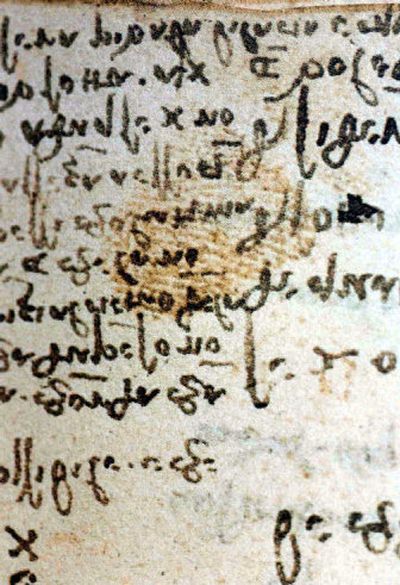
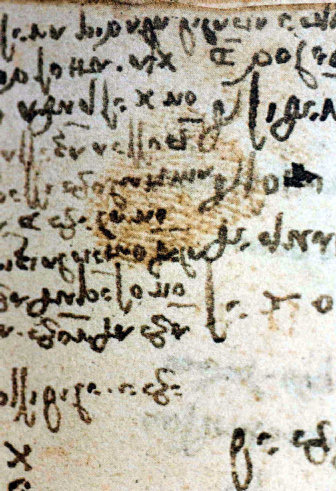
ROME – Anthropologists said they have pieced together Leonardo da Vinci’s left index fingerprint – a discovery that could help provide information on such matters as the food the artist ate and whether his mother was of Arabic origin.
The reconstruction of the fingerprint was the result of three years of research and could help attribute disputed paintings or manuscripts, said Luigi Capasso, an anthropologist and director of the Anthropology Research Institute at Chieti University in central Italy.
“It adds the first touch of humanity. We knew how da Vinci saw the world and the future … but who was he? This biological information is about his being human, not being a genius,” Capasso said in a recent interview.
The research was based on a first core of photographs of about 200 fingerprints – most of them partial – taken from about 52 papers handled by da Vinci in his life. Capasso’s work, presented in 2005 in a specialized magazine called Anthropologie, published in the Czech Republic, is on display in an exhibition in the town of Chieti through March 30.
The artist often ate while working, and Capasso and other experts said his fingerprints could include traces of saliva, blood or the food he ate the night before. It is information that could help clear up questions about his origins.
Certain distinctive features are more common in the fingerprints of some ethnic populations, experts say.
“The one we found in this fingertip applies to 60 percent of the Arabic population, which suggests the possibility that his mother was of Middle Eastern origin,” Capasso said.
Other experts, however, say that determining ethnicity based on fingerprints is vague.
What the science says, “generally speaking, is that if your parent has a lot of arches, you’ll probably have a lot of arches,” said Simon Cole, associate professor of criminology, law and society at the University of California at Irvine.
“The science essentially comes up with breakdowns: x percent of Asians have arches, x have whorls, x have loops. Some races have very low incidences of some patterns and very high incidences of others.”
But “you can’t predict one person’s race from these kinds of incidences,” he said, especially if looking at only one finger.
The idea that da Vinci’s mother could have been a slave who came to Tuscany from Constantinople – now Istanbul – is not new and has been the object of other research.
Alessandro Vezzosi, a da Vinci expert and the director of a museum dedicated to the artist in his hometown of Vinci, said there are documents that appear to back this up.
“This coincides with documented indications that she was Oriental, at least from the Mediterranean area, not a peasant of Vinci,” he said.
Biological information on da Vinci is largely incomplete. The artist, who was generally but not exclusively left-handed, used his fingers to paint, and his thumbprint recurs on the manuscripts, Vezzosi said. Da Vinci sometimes worked while eating or traveling, and his fingers were often dirty, sometimes with residue of food, Vezzosi said.