
Young hunters on decline

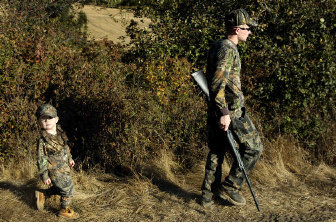
MINNEAPOLIS – The age-old battle between deer and deer hunters might soon be won by deer. Minnesota is just an example for issues confronting many states across the country.
Already nearly out of control around the Minneapolis metro area, the state’s whitetail herd could grow still larger if trends continue and more young Minnesotans forgo the hunting traditions of their parents, grandparents and great-grandparents.
Consequences of a decline in hunters are far-reaching.
“We can’t manage deer populations without people out there shooting them,” said Department of Natural Resources big-game specialist Lou Cornicelli.
In Minnesota, thousands of collisions between cars and deer now occur every year, whitetails chomp indiscriminately on homeowners’ shrubbery, and northwoods white pine seedlings get nibbled to nothing. Some local governments are struggling more than ever to cope with so many deer.
This fall, Minnesota’s 500,000 deer hunters are expected to kill about 250,000 of the state’s 1.3 million whitetails. But times seem to be changing: During the past five years, resident hunters ages 16 to 44 declined almost 11 percent.
Nationally, hunting participation fell 17 percent in just 10 years, beginning in 1991, a period during which hunting in Minnesota also dropped as a percentage of its population.
“There appears to be a generational shift in Minnesota away from all outdoor activities, including hunting, fishing and wildlife watching,” said DNR researcher Tim Kelly.
The decline often is blamed on urbanization, an increase in single-parent families, the popularity of youth team sports and the lack of opportunities to hunt.
Any falloff in hunters also has significant implications for conservation funding, including wildlife habitat development. About 85 percent of hunting revenue in the DNR Game and Fish Fund comes from deer hunting.
Ironically, 25 years ago, the state had so few deer the DNR canceled the firearms season.
Responding to hunters’ desires for more animals, the DNR in 1975 began to limit the number of does, or female deer, hunters could kill. Permits to kill antlerless deer were distributed beginning that year to lottery winners from a pool of applicants.
That management shift, along with landscape changes statewide – including an intensification of soybean and corn row-cropping and the broad expansion into the hinterlands of lawns and other clearings – have combined with fewer brutal winters to boost whitetails.
The flourishing herd now seems free of natural barriers to its growth.
Without options other than hunting to control deer – birth control experiments have failed and contract sharpshooters are expensive – DNR wildlife managers in 2003 largely scrapped the antlerless permit lottery.
“Except in the southwest part of Minnesota, we’re back to a ‘kill everything’ deal in the state,” Cornicelli said.
Growing up a hunter
Brian Arndt grew up in Osceola, Wis., just over the border from Minnesota, hunting deer with his dad and brothers.
Today, Arndt, 34, is a construction manager living in Minnetonka, married with two children. Though still a pheasant, ruffed grouse and duck hunter, he no longer hunts deer.
“Deer hunting is a big commitment,” he said. “You need land and time off from work. Deer hunting just takes a lot more effort than getting up early on a Saturday with some friends for a day of duck or pheasant hunting. I can do that and get back in time to be with my kids.”
Data mined from the DNR’s electronic licensing system show consistent participation in deer hunting among youth ages 12 to 15 between 2000 and 2005. But a falloff of 10 percent occurred during that period among hunters ages 16 to 24, relative to the state’s growing population. A similar drop was found for those 25 to 34 – Arndt’s age group.
The state’s growing deer herd and its ability to adapt to modern landscapes are not the only issues confounding wildlife managers. Deer hunters’ changing desires and expectations also are a complication.
Until recently, most Minnesota whitetail hunters were fairly happy just to kill a deer – doe or buck. Now, dulled by what in some parts of the state can be a near-parade of small does before hunters’ stands, and cultivated by TV shows and magazines whose focus is record-book antlers, many hunters rate a herd’s health less by its overall size than the trophy animals it boasts.
Still, the state’s ever-larger deer herd has been attracting ever more hunters. Before the deer-management changes made in 1975, the most hunters that Minnesota put in the field was 323,000 in 1968. That mark has been surpassed every year since 1977, peaking in 1994, when more than 530,000 licenses (including those for archery) were sold.
But it’s the declining percentage of hunters younger than 45 that concerns wildlife managers.
“Demographics worry us,” said DNR fish and wildlife policy section chief Ed Boggess. “We’re not seeing the same participation in hunting, even in Minnesota, among young people, as has been the case historically.”
A tradition reborn
Surveys of active, adult hunters by the U.S. Fish and Wildlife Service indicate that almost 80 percent had their first hunting experience before age 15.
People exposed to hunting later in their lives are less likely to stick with it.
A recent National Shooting Sports Foundation study citing a “hunter replacement ratio” in Minnesota of 0.59. A ratio of 1.0 is needed to sustain hunter numbers, the study said.
Many hunters are ambivalent about the falloffs. The percentage of the population that hunts might be declining, they say, but the state’s and nation’s hunter numbers remain high.
In fact, in 2000, the DNR sold 250,000 more hunting licenses than it did in 1970, though the percentage of licenses issued in the two periods relative to the state’s population remained fairly stable.
“But when baby boomers are gone,” Boggess said, “we could have problems keeping hunter numbers up. Which is another reason we want to keep the state’s deer herd at a manageable level. We might not have as many hunters in the future as we do now.”
Big money at stake
A decline in deer hunters would take an economic toll around the state, too.
At Sportsman’s Warehouse, Gander Mountain, Cabela’s, Dick’s and Joe’s Sporting Goods, blaze-orange clothing, guns and ammunition fairly flew out the doors during October.
Few things are as good for business as deer hunting. And fully 80 percent of all hunters in Minnesota hunt deer, according to the U.S. Fish and Wildlife Service.
Deer hunters take twice as many trips as non-deer hunters, spend twice as many days on those trips and spend up to four times as much money on special equipment as other types of hunters do.
Total expenditures for deer and non-deer hunters nationally in 2001, according to the Fish and Wildlife Service, were $20.6 billion, of which deer hunters generated $18 billion.
Cornicelli sees a Minnesota deer-management future in which hunters – whatever their number – might not necessarily be asked to kill more than the quarter-million animals they will kill this fall. But they might be asked to kill more does and fewer bucks.
That could be accomplished by requiring hunters to kill a doe before killing a buck, thereby reducing a herd’s reproductive capacity.
“We’re trying to manage the state’s herd for a whole bunch of considerations, one of which is hunting,” Cornicelli said. “A population like we have now, at 1.3 million deer, is about the limit. We simply can’t manage statewide for a higher deer population, say of 1.5 million deer.
“Deer have too many impacts on farms, native plants, cars and people.”