
Chavez wins in Venezuela
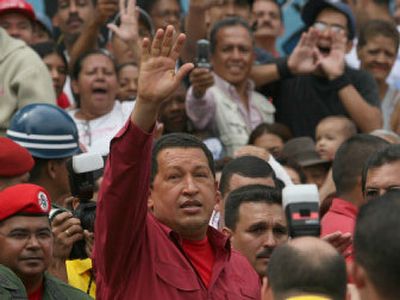
CARACAS, Venezuela – Venezuelans overwhelmingly re-elected President Hugo Chavez on Sunday, extending a presidency that began when he was swept into power eight years ago. The populist leader will receive six more years in office to broaden his leftist revolution and cement his government as the most defiant anti-Bush administration voice in Latin America.
With 78 percent of the votes counted by 10 p.m., electoral authorities announced Chavez, 52, had secured 61.3 percent of the vote to 38.4 percent for Manuel Rosales, whose candidacy united a fractured opposition but had only four months to gather momentum. Chavez’s tally presented an insurmountable lead.
Chavez ‘s “Bolivarian revolution” is set to last until at least 2013, though Chavez told reporters Thursday that a change to the constitution could permit him to rule even longer.
“I’m not planning to say in the constitution, ‘Hugo Chavez will remain in the presidency until he dies,’ because that would be perverse,” said Chavez, who under the law can serve only one more term. “It’s very different to study the possibility of indefinite re-election. It will always be the will of the people.”
Rosales campaign officials said voting equipment malfunctioned at several polling sites and there were delays in pro-Rosales districts. But authorities with the five-member National Electoral Council said they had not found serious discrepancies.
“Everything is perfectly normal in the country,” Vicente Diaz, who is considered partial to the opposition, said Sunday night. Observers from the European Union, the Atlanta-based Carter Center and the Organization of American States monitored the vote and reported only isolated incidents by early Sunday night.
A Chavez victory further consolidates the tide of leftist politicians who have won office in Latin America in recent years, including Luiz Inacio Lula da Silva in Brazil; Michelle Bachelet in Chile; and Evo Morales in Bolivia. Although Colombia, Peru and Mexico this year elected pro-trade, pro-U.S. presidents, leaders who criticize market reforms and sharply question the Bush administration’s policies in the region were elected last month in Nicaragua and Ecuador.
Chavez has said he would ensure that Venezuela, which says it has the largest oil reserves outside the Middle East, remains a price hawk in the Organization of the Petroleum Exporting Countries.
He has also said he would solidify Venezuela’s relations with Cuba and Iran, countries the Bush administration is working to isolate. Chavez , who survived a 2002 coup tacitly endorsed by the White House, often accuses Washington of backing undemocratic opposition groups.
With oil prices having reached historic highs, and Chavez’s Fifth Republic Movement in control of the National Assembly and other institutions, the government has funneled billions of dollars into education, health and nutrition programs.