
Gates: U.S. not winning
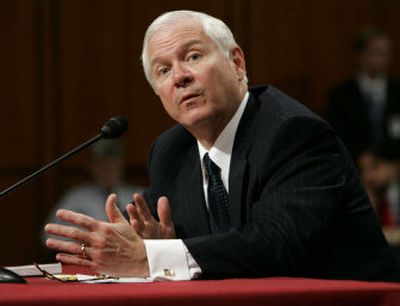
WASHINGTON – Robert M. Gates, President Bush’s nominee to become Defense secretary, testified before Congress Tuesday that the United States is not winning the war in Iraq despite three years of fighting and efforts to stabilize the country, and that he would consider new solutions including a gradual withdrawal of U.S. troops.
Appearing before a Senate committee weighing his confirmation, Gates proved a sharp contrast to the outgoing Defense secretary, Donald H. Rumsfeld, who repeatedly and briskly defended the administration’s conduct of the war and its ultimate merit before his resignation last month.
Gates labeled several administration decisions on Iraq as clear mistakes that helped to compound the current problems in the country.
“I suspect in hindsight some of the folks in the administration probably would not make the same decisions that they made,” Gates said. “There clearly were insufficient troops in Iraq after the initial invasion to establish control over the country.”
His more conciliatory approach seemed to mark a new phase in which recriminations over the war’s origins give way to debates over how to extricate U.S. forces without leaving chaos behind.
“Dr. Gates, thank you for your candor,” said Sen. Hillary Rodham Clinton, D-N.Y. “That’s something that has been sorely lacking from the current occupant in the position you seek to hold.”
Gates was warmly received by the Senate Armed Services Committee, which unanimously approved his nomination just hours after the hearing. Gates could take office before the end of the month once he receives the backing of the full Senate, expected to come today.
For the unassuming former intelligence analyst, whose bureaucrat’s disposition seems at odds with a career spent in the inner circles of power, it was a remarkable result. His last confirmation hearing in 1991, for the post of CIA director, lasted months, airing charges that he slanted intelligence reports and was linked to the 1980s-era Iran-Contra scandal.
The tone on Tuesday was unlike any of scores of hearings in recent years on Iraq, as the military’s predicament and congressional impatience and anxiety have grown more acute. Gates responded simply and directly to questions that would have provoked a furor in Rumsfeld’s day.
“Mr. Gates, do you believe that we are currently winning in Iraq?” asked Sen. Carl Levin, D-Mich., who will become chairman of the Senate Armed Services Committee when Democrats take over Congress.
“No, sir,” Gates replied, without elaboration.
Gates’ assessment, markedly more dismal than any advanced by the administration, conflicted with Bush’s own claim as recently as six weeks ago at a major White House news conference that, “Absolutely we’re winning.”
Gates diverged from administration positions on several occasions during five hours of questioning. He said the U.S. did not use enough troops to stabilize Iraq after the 2003 invasion, erred in liquidating the Iraqi military after its defeat and went too far in removing Baathist Party officials from government – three key administration moves blamed for allowing violence and disorder to spread through the country.
Gates, a supporter of the war in 2003, even declined to answer a question from Sen. Mark Dayton, D-Minn., whether he now believed the invasion itself was a good idea.
“Frankly, senator, I think that’s a judgment that the historians are going to have to make,” Gates said.
Gates’ testimony put the White House on the defensive, forcing officials to insist that Gates shares Bush’s views on the value of building an Iraqi government that can sustain and defend itself.
“I know that you want to pit a fight between Bob Gates and the president,” said White House spokesman Tony Snow. “It doesn’t exist.”
Quick approval by the Senate would differ from Gates’ confirmation hearing in 1991, one of the longest and most contentious in recent Senate history. Then, Gates was grilled on accusations that he bullied analysts into shaping intelligence to fit the Reagan administration’s worldview.
Some of the questions were raised again Tuesday. Both Democrats and Republicans pressed Gates about whether he would be honest with Bush in his views of Iraq, even if they were pessimistic, and insisted he allow military leaders to be equally blunt in their assessments. Rumsfeld has been accused of stifling dissent within the Pentagon.
Gates promised to welcome differing views, and insisted he himself would pull no punches.
“I am not giving up the presidency of Texas A&M, the job that I’ve probably enjoyed more than any that I have ever had … to come back to Washington to be a bump on a log,” Gates said. “I can assure you that I don’t owe anybody anything.”
Although Gates was intentionally vague about which strategic route he preferred – refusing to answer several questions on troop levels until he consulted with military commanders – he drew several lines. He was cool toward a firm timetable for withdrawal, saying it would telegraph to U.S. adversaries how long they needed to wait before re-launching an attack on the Iraqi government.
But he acknowledged that the number of U.S. troops did not constitute an “overwhelming force” and signaled he was open to enlarging the size of the Army and Marine Corps in order to find more troops for Iraq.
“My greatest worry, if we mishandle the next year or two and if we leave Iraq in chaos, is that a variety of regional powers will become involved in Iraq, and we will have a regional conflict on our hands,” Gates said.
He added that he did not believe there were any new ideas on Iraq, but that the key was to find the right mix of such policies.
Still, it was Gates’ apparent willingness to distance himself from previous administration policies in Iraq that drew the most attention from committee members. He went so far as to single out for criticism a Pentagon group set up by Douglas Feith, the former undersecretary for Defense, which performed independent analysis of U.S. intelligence ahead of the Iraq war.
The group, formally called the Policy Counterterrorism Evaluation Group, was a favorite of Rumsfeld and Vice President Dick Cheney, who insisted it provided valuable independent assessments of possible links between Iraqi leader Saddam Hussein and al-Qaida terrorists.
But Gates said that bypassing the CIA and Defense Intelligence Agency in such instances was a mistake.