
Fresh signs of water seen on Mars
NASA scientists announced Wednesday that they had found evidence that water still flows over the surface of Mars – sporadic gushers that increase the possibility that the Red Planet could harbor some form of life.
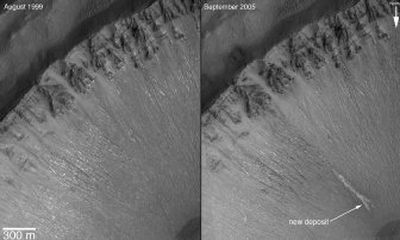
Using images obtained by the Mars Global Surveyor spacecraft, the researchers concluded that geologic changes in the shapes and sizes of gullies cut into the walls of two Martian craters were likely made by flowing water.
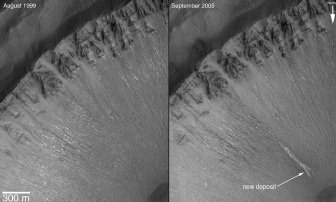
The team looked at two sets of images taken several years apart. In both cases, the second set of images revealed a light-colored substance several hundred yards long that had not been there before, indicating that something had erupted from the ground and apparently sloshed toward the bottom of the basin.
NASA’s two rovers, Spirit and Opportunity, which are on the surface of the planet, found evidence that water covered large areas of Mars billions of years ago.
“Today, we’re talking about liquid water being present on Mars right now,” said Ken Edgett, a staff scientist at Malin Space Sciences in San Diego, which built the camera that took the pictures released Wednesday.
“You have all heard of a smoking gun,” he said. “This a squirting gun.”
The findings, to be published in the journal Science, pose more issues for scientists to grapple with. “The big questions are: How does this happen? And does it point to a habitat for life?” said Michael Meyer, lead scientist for NASA’s Mars Exploration Program.
The answers will not come soon. The two rovers, which could investigate further, are both hundreds of miles away from the gullies described Wednesday.
Still, the discovery, if confirmed, would give the search for extraterrestrial life a new focus.
In another major finding, members of the science team said they found 20 new impact craters, ranging from 7 feet to 486 feet across, in other images from Global Surveyor. The scientists said the number of new craters indicated impacts from meteors could be a hazard if astronauts tried to establish a base on the planet.
The discoveries announced Wednesday were something of a surprise, because the Mars Global Surveyor, launched in 1996, is considered old technology.
NASA recently announced that it had lost contact with the Global Surveyor because of a malfunction – making Wednesday’s announcement all the sweeter. The craft’s original mission life was supposed to last just two years.
Over the spacecraft’s extended lifetime, its camera produced some 240,000 images. Finding the evidence of water required scrutinizing pictures of tens of thousands of gullies at hundreds of sites on the Martian surface.
The findings came from images taken in 2004 and 2005. The team saw a white crust or patch on the surface in gullies in the Terra Sirenum and Centauri Montes regions of southern Mars that they hadn’t noticed before. Looking back to images taken in 1999 and 2001, they confirmed the deposits were new.