
Remembering a day of infamy
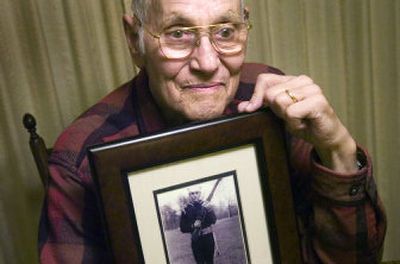
A night on the town kept Floyd M. Johnson alive during the Japanese assault on Pearl Harbor.
“Old-Fashioneds saved my life,” said the Lewiston resident as he recalled the stark details. Johnson plans to drink those same cocktails again today, as he and his sons mark the 65th anniversary of that Dec. 7, 1941, surprise attack.
Nearly 2,400 Americans died that day at Pearl Harbor, while Johnson and other survivors did their best to save those they could.
Johnson, a Navy seaman on the USS Pennsylvania, had imbibed a bit too much, fallen, hit his head and was in the infirmary when the Japanese began bombing the U.S. ships in the Hawaiian harbor.
“I saw the planes. We realized we were at war,” said Johnson, who hurried back to his ship, then in dry dock, only to find that his duty station had been destroyed.
He soon began helping with rescue and recovery efforts, pulling injured and dead sailors from the harbor even as he had to dodge machine-gun fire from the Japanese planes.
“There were burned bodies and burned people. Their burned flesh – I hadn’t seen that before. I had to put cotton balls where they used to have eyes. Some could speak but died in just a few minutes. It was pretty bad stuff,” Johnson said.
He was 17 years old at the time.
Spokane’s Bill Paulukonis was just on his way back to barracks after breakfast when he heard the bombing.
“It was a lot of turmoil, of course, when we discovered we were being attacked,” said Paulukonis, who was with the U.S. Army Corps of Engineers at the time.
He had been working in sugar cane fields the week before, preparing anti-aircraft gun mounts for any possible attack, but he and other engineers never expected the low-level attack that came and sank the USS Arizona and other Navy ships that day.
Survivors of the assault that began the U.S. war with Japan are meeting now for their last official reunion at Pearl Harbor. Most are in their 80s, and travel is becoming difficult.
Paulukonis said he’s been to many reunions but didn’t attend the 60th or the events this year. “I’m getting too old,” said the 88-year-old.
Others remember the attack from a different perspective.
Clarence “Chic” Juber was aboard the USS Portland, which left Pearl Harbor three days before the Japanese bombing.
Juber recently thumbed through an issue of Life magazine chronicling the attack and the ensuing days, as he recalled the time.
The story had originally been intended to be a general feature on life aboard a Navy cruiser but instead became a story about the first 10 days of war with Japan. Juber’s photograph appears twice with the story, once in a lifeboat and again painting the ship.
When word of the attack came to the Portland, the crew was instructed to throw everything flammable overboard and to paint any shiny surfaces gray so that the ship would be less visible, Juber said. They started steaming fast back toward the island.
“I knew that it was serious,” he said.
Juber felt both lucky and mad when he found out about the attack. He and his shipmates felt only anger when they saw the devastation. It strengthened his and the United States’ resolve to fight Japan.
“I remember seeing the Nevada. It was rammed up on the beach,” he said. “On our right was the Arizona, sunk. The Utah was sunk. We were ready for whatever they wanted us to do.”