
Sweetpea connects
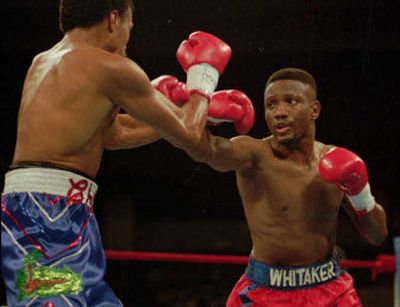
NORFOLK, Va. – Pernell Whitaker, who in his prime was harder to hit than a lottery jackpot, has been elected to the International Boxing Hall of Fame, tying a bow on a career that took him from Norfolk’s Young Terrace housing project to the pinnacle of his sport.
Whitaker, 42, won an Olympic gold medal, six world titles and, at his peak, widespread acclaim as the world’s best fighter, pound for pound.
He’ll be inducted in June in a ceremony in Canastota, N.Y., home of the Boxing Hall of Fame.
“I don’t think I’ve ever looked forward to anything more than this,” Whitaker said. “When they called me and told me, I got weak.
“Things come and go, but the Hall of Fame will be here for eternity.”
Nicknamed “Sweetpea,” Whitaker tied the best fighters of his era in knots with a unique crouching defensive style. He would slip away from their punches, then counter from unconventional angles. Boxing historians generally rank him alongside featherweight Willie Pep as one of the top defensive fighters of all time.
“You couldn’t hit Pernell in the backside with a handful of buckshot,” said author and historian Bert Sugar, who rated Whitaker No. 48 in a book on the 100 greatest boxers. “To me, a man wins a fight by imposing his will on the other man. When he did what he did and did it well, he imposed his will on everybody.”
Lou Duva, Whitaker’s former manager, said, “He was one of a kind. When he didn’t want to get hit, he didn’t get hit.”
Whitaker compiled a record of 40-4-1, with 17 knockouts, in a pro career that stretched from 1984 to 2001. He won world titles as a lightweight, light welterweight, welterweight and light middleweight. He earned seven-figure purses and had a 10-year run as the star attraction for HBO Sports.
Later in his career, his ring achievements were nearly overshadowed by struggles with drug addiction. He tested positive for cocaine after a 1997 fight. Following his retirement, he served two years for possession.
Whitaker was released in April 2005 and has lived quietly in Chesapeake since. He makes appearances for Main Events, the firm that promoted his fights. He also trains local junior welterweight Dorin Spivey and can be found most weeknights working with everyone from 8-year-olds to professionals at a gym in Portsmouth.
In easing back into society and launching a career as a trainer, he has followed his own mantra: Get it down, get it done, stay focused, be patient and appreciate.
“Now, good things are starting to happen for me,” he said.
Earlier this week, Whitaker was back at Wareing’s Gym in Virginia Beach, where he trained most of his career, overseeing one of Spivey’s sparring sessions and scouting a new fighter.
Whitaker prepared for most of his biggest bouts at Wareing’s, where his training camps would sometimes include fellow world champions such as Evander Holyfield and Meldrick Taylor.
His most famous bout came on Sept. 10, 1993, against Julio Cesar Chavez in front of an overwhelmingly pro-Chavez crowd of 59,000 at the Alamodome in San Antonio. Chavez brought a record of 88-0 into the fight and was a legend in his native Mexico.
Whitaker dominated Chavez most of the fight, but judges ruled it a draw.
Whitaker appeared on the cover of Sports Illustrated the next week. The headline “Robbed!” – summed up the feelings of boxing fans everywhere.
The Chavez fight solidified Whitaker’s claim as the world’s best boxer. He went unbeaten the next four years before losing another controversial decision, this one to Oscar de la Hoya, in 1997.
“He was a dominant boxer and sometimes a boxer-puncher,” HBO boxing analyst Larry Merchant said. “There was very little drama in his fights. He went for long periods where he didn’t lose a round.”
Whitaker’s style appealed to purists, if not those fans itching to see a brawl. A more aggressive style might have made him more popular, Merchant said, but Whitaker headlined 19 fight cards for HBO in the 1990s.
Whitaker began boxing at age 7 and entered local tournaments at 8. Friends and family called him “Pete,” and at amateur bouts, fans would chant “Sweet Pete” as Whitaker dazzled with his lightning-fast hands and defensive artistry.
A local sportswriter misunderstood the chants as “Sweetpea,” using the nickname in print.
Whitaker climbed the amateur ranks and captured a world championship in 1982 and a gold medal in the lightweight division at the 1984 Olympics.
It was an era when Olympic boxing was on prime-time television and American medalists were well known.
He made a seamless transition to the pro ranks, establishing his reputation as a consummate boxer. He won his first 15 bouts before losing a widely ridiculed decision to Jose Luis Ramirez in France in 1988. Whitaker avenged the loss 17 months later at Scope.
Whitaker’s signature bouts included a pair of decisions over James “Buddy” McGirt for the WBC welterweight title, including one at Scope in 1994. He dethroned Julio Cesar Vasquez to win the 154-pound title in 1995.