
Dig uncovers city’s antiquity
An archaeological dig at the confluence of the Spokane River and Latah Creek has proved that human habitation there dates back 8,000 years in what was an apparent seasonal encampment for gathering and processing food.
The discovery means that Spokane is possibly the oldest city in Washington in terms of continuous human use, said Stan Gough, director of archaeological and historical services at Eastern Washington University. Or, at least it’s the oldest that’s been proven by radiocarbon dating.
Oral Indian history has long held that the alluvial delta separating the two waterways downstream from Spokane Falls was a choice location for harvesting salmon and other foods through the millennia.
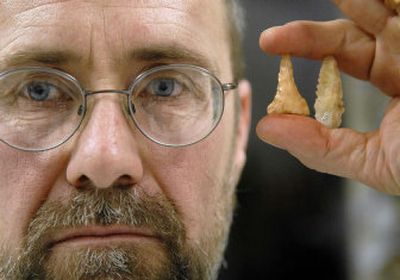
During five months of work, archaeologists from EWU uncovered 60,000 artifacts, including an obsidian arrow point made out of volcanic glass from Eastern Oregon, clothing needles made of bone and an adz blade cut from nephrite, a type of jade found in the Wenatchee area.
Spear tips known as “Cascade points,” used throughout the region from 4,000 to 8,000 years ago, were found in the oldest layers at the site. The finds confirm that regional trade was part of the indigenous culture, Gough said.
A technological progression was found as well. Rock net weights dating back about 3,500 years indicate that people were seeking larger amounts of fish apparently to dry and store for winter or as a trade commodity. Arrow points to about 1,000 years old were found in shallower strata.
The vast majority of the recovery was broken animal bone and rock chips dropped to the ground during camp.
Three samples of charcoal recovered at 4 to 7-plus feet in depth were tested for radioactive isotopes to establish their ages at 8,000 years, Gough said.
Layers of sand separating the samples showed that they came from different campsites over a period of possibly hundreds of years.
“Every excavation yields new things,” said Gough. “This one was a particularly information-rich site.”
A favorable ebb and flow of river water may have contributed to preserving the artifacts. A flood might normally wash away campsite remains, but for some reason, the two waterways pushed sand on top of the old campsites, smothering them in a fairly sterile layer of sediment that sealed them from deterioration, Gough said.
Even so, no wood or clothing survived. “All of the baskets are gone,” Gough said, and only rock, charcoal and bone remained.
“This documents for the first time people actually living here at this age,” he said.
The 25-by-60-foot dig was undertaken because the city sewer utility is under a state mandate to install overflow tanks for combined sewer and storm water lines coming off the south side.
Dale Arnold, wastewater director, said the cost of the $430,000 dig was far less expensive than placing the tank in another location.
Otherwise, the city wants to avoid culturally sensitive sites, he said.
The dig, required under state antiquities law, is by far the largest such excavation ever undertaken by the city. Elsewhere in the region, Clovis points found near East Wenatchee date back 10,000 years, and the remains of Kennewick Man date back about 9,600 years.
For native descendants, Spokane’s radiocarbon dating comes as no surprise.
“We’ve known that all our lives,” said Buzz Gutierrez, a Spokane Indian tribal member who was born and raised in Peaceful Valley just upstream from the traditional encampment.
“Our history is all oral history, of course,” he said, describing the dig as a double-edged sword. While it disturbed his ancestors’ past, it also validated what he and his people have been saying for many years.
“It’s great for me to know that somebody is going to admit that native peoples have been here for more than 3,000 years,” he said. “We can say to the Europeans, ‘We’ve been here longer than you thought.’ “
From an archaeologist’s point of view, the most significant discovery was a perfectly intact counterweight instrumental in an early weapon system widely used by hunter-gatherer cultures.
The counterweights were retrievable, so fewer of them were made.
It was a key component of an “atlatl,” a leveraged spearing device that used a small rock Cascade point at the end of a two-pieced wooden shaft.
The dig found no evidence of winter shelters. Also, bones of mammals such as marmots, which hibernate, indicated that the natives were at the site during warm-weather months.
Sara Walker, an EWU archaeologist on the dig, said that an oven hearth lined with river mussel shells showed how the natives cooked and consumed food.
Artifacts found next to carbon samples were dated to 2,500 years ago, but the scientists believe that human use of the area continued into modern history. “I’m sure there was later occupation,” Walker said.
The animal bones identified were: elk, deer, dog, wolf, coyote, marmot, rabbit, squirrel, black bear, beaver, mink, otter and western painted turtle. A beaver tooth apparently was used as a chisel for engraving decorative pieces, the scientists said.
Fish bones were plentiful, including salmon or trout, which are in the same genus and difficult to distinguish from bones. But the natives also apparently consumed mountain whitefish and suckers.
Because the delta is being held as city park open space, it is questionable whether it will ever be excavated for additional archaeological evidence. Walker said that simply installing a lamp post would require a survey and possible excavation. As a result, the EWU researchers saved a large quantity of samples for later research.
Gutierrez said if the site remains untouched forever, that would be fine with him.
“It should be protected and not disturbed,” he said. “The significance to me is we knew it was there. Now you know it’s there.”