
50 years on the fly
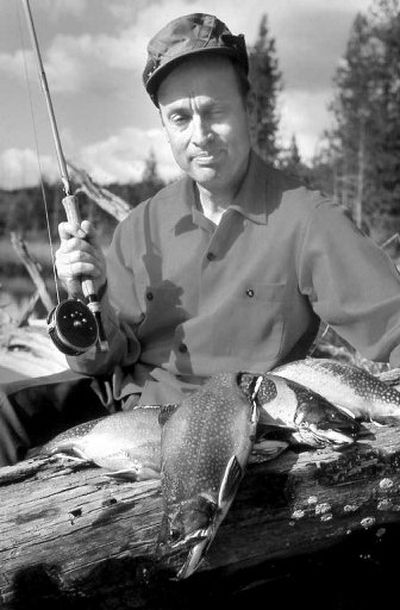
Fifty years ago, a handful of men formed the Inland Empire Fly Fishing Club to mix camaraderie and education with the work of improving the stature of fly fishing throughout the region.
That much has never changed.
In the 1950s, club members could fill gas tanks for fishing excursions at around 25 cents a gallon. A good fly-fishing outfit could be put together for about $40, including an 8-foot glass rod for $20, a $10 double-taper dry line and a single-action reel for about $3. However, Fenton Roskelley, Spokane Daily Chronicle outdoor writer and club member, noted at the time that anglers would be flirting with regret if they tried to get into the sport on the cheap by paying only $15 for a rod.
By late 1970s, members were making the transition from fiberglass to graphite rods. Now it’s not uncommon to pay $300-$600 for a rod alone.
Popular fly patterns of the ‘50s – such as the Carey Special, Silver Nymph, Mosquito Larvae, Snow Fly, Sand Fly Nymph and Carrot Nymph – have faded from fly boxes nowadays and club members who killed and ate virtually all of the fished they landed before the 1970s now religiously practice catch-and-release at their favorite trout fisheries.
But Inland Empire Fly Fishing Club regular meetings continue to be held monthly except for summers, when, as always, the meetings are informal and along good trout streams.
The membership is still limited to 135 and applications are screened more scrupulously than ever by a committee to assure that new members are willing to be involved in club projects.
Women need not apply. The club is for men only.
“Some of the best fly fishers I know are women, but the club has always been this way and I’m OK with it,” said Dick O’Dell, a retired school administrator whose 15-year-membershp is nowhere near veteran status. “Our wives don’t mind. After all, when we go on club fishing trips, I think they’re happy that it’s just the boys.”
Spokane has the option of another club, the Spokane Fly Fishers, which encourages all family members to join, O’Dell pointed out. “Many Inland Empire club members, myself included, belong to both clubs,” he said.
Indeed, members of both clubs are hooked by trips and programs that help them learn more about the sport of fly fishing. They are leaders in fish conservation efforts; they regularly wade into research projects, mend lines between public and private fishing interests, and they know how to cast behind the scenes and reel in regulations that will improve fisheries.
But the Inland Empire club has a blood-brother sort of edge.
The informal weekly lunch gathering to exchange fishing information is affectionately called The Liar’s Club. Every monthly meeting begins with fear and loathing as “The Poacher” prowls the rumor mill and boosts the club treasury at the expense of members who have strayed from fly-fishing protocol.
For example, The Poacher – a post that rotates among the club’s most ruthless deadpan humorists – stood up for family values a few years ago by bringing member Bob Harley to justice for conduct unbefitting of an angler/husband.
Not that any of the members are particularly innocent of irking their spouses with the odor of wet waders and all the sand, slime and ego that comes home with them. But Harley went over the edge.
Club members were informed that after returning from a fishing trip to Tamarack Lake, British Columbia, Harley dumped his float tube and other gear in the basement. This probably wouldn’t have been a problem if a rattlesnake hadn’t holed up unnoticed in Bob’s float tube. His wife, Molly, was the first American to greet the reptile here in the land of plenty, and if she had been the wife of a meat fisherman maybe she wouldn’t have been quite so startled.
Anyway, The Poacher found Harley guilty of wife abuse and fined him $5, which is about half the fine he’d have got if the club had suspected he was using snakes, worms or other bait as a way to lure trout.
Aside from the fun and fishing, service is at the foundation of every club meeting.
In the 1960s, even before Montana would introduce a $1 non-resident daily fishing license, the club made the pitch to the Washington Game Commission to designate Bayley Lake for fly fishing only. With those restrictions in the books, club members have conducted many projects to improve spawning and habitat at the lake on the Little Pend Oreille National Wildlife Refuge.
Their efforts also have boosted fisheries at waters such as Amber, Coffeepot, McDowell and Rocky Ford, to name a few, and they’ve assisted fish researchers in waters from the Columbia Basin to the Coeur d’Alene and St. Joe rivers in North Idaho.
In 1962, the club published for internal use, “A Dictionary of Popular Inland Empire Fly Patterns – six mimeographed pages of “recipes” for 58 fly patterns used in local waters. This evolved by 1965 into a book. Most recently revised in 1998, “Flies of the Northwest,” featuring more than 200 popular patterns and how to fish them throughout the region, has raised thousands of dollars for the club’s fish conservation projects.
By 1976, as float tubes were becoming nearly as common as boats on popular fly-fishing waters, the club was receiving national recognition for a variety of conservation efforts, including installing winter aeration devices at lakes, trout sterilization projects and more.
In the 1980s, as personal pontoon boats were replacing float tubes as the area fly fishers craft of choice, the club began teaching beginner fly-fishing class at schools and community colleges. They pushed for conservative trout limits on the Spokane River and bought equipment to help state biologists manage local fisheries.
In 1999, club members negotiated public access that had been lost to North Silver Lake, which has the potential to be one of the region’s best fisheries. Veteran member Fred Shiosaki was appointed to the Washington Wildlife Commission that year, a position he still holds.
Most recently, the club helped fund Eastern Washington University research on biomass in 23 lakes throughout Eastern Washington to help state biologists understand how many fish the waters can support.
In 50 years, the club has seen great fisheries come and go. One of the most popular spots in the ‘60s and ‘70s was fishing for lunker rainbows right off the Balfour ferry landing at Kootenay Lake, British Columbia. Club historian Leon Buckles described some close calls, “especially when you had on one of those 5- to 10-pound fish with a huge ferry bearing down on fly fishermen in their 12-foot boats.”
Of course, The Poacher would prey upon any report of an angler purposely breaking off a big trout to avoid a few hundred tons of ferry boat.
Ask Ray Kranches.
After a pleasant day of fishing in the Columbia Basin a few years ago, Kranches neatly folded his expensive Gore-Tex rain jacket and packed it in his float boat along with boxes holding about 300 flies and all kinds of other fly-fishing gear, none of which is cheap, even on sale.
He loaded it all in the back of his rig.
He said his partner tied it in.
At Wilbur, Wash., they looked back and the whole outfit was gone.
He drove back along Highway 2. He searched, called the sheriff, agonized. We’re talking big bucks here.
“I felt like giving up the sport of fly fishing,” he said a the next club meeting, shaking his head with the sadness of a hunter who’s just lost his best bird dog.
The club members treated Kranches with the compassion to which the brotherhood has been accustomed.
They fined him $1.