
Your Good Health: Blood pressure basics

Dear Dr. Donohue: I am writing about my husband’s recently diagnosed hypertension and my concerns about it. His doctor recommends a home blood pressure unit for him. I wonder if the stress of using a home monitor will raise his blood pressure. I would like to know what the consensus is among doctors for a normal reading. — W.W.
Answer: Ideal blood pressure is one that is less than 120 over 80. A new category of hypertension is prehypertension, whose readings are 120 to 139 over 80 to 89. Stage 1 hypertension is 140 to 159 over 90 to 99, and stage 2 is any value equal to or greater than 160 over 100. If one number is normal but the other number is not, the abnormal number is the one that is used to determine the classification.
For prehypertension, doctors have their patients make changes in the way they lead their lives. They’re told to lose weight when indicated, to decrease salt use, to increase potassium and to exercise for at least 30 minutes on most days of the week.
A word about salt is in order. Decreasing salt intake means more than taking the saltshaker off the table. It means reading labels for the sodium content and avoiding salted products, like most luncheon meats. Treatment of prehypertension can stop the progression of blood pressure to hypertension and protects organs from the damage of high blood pressure.
For stage 1 hypertension, the above is prescribed and medicines are given if there’s any evidence of changes in the eye, the heart or the kidney. If blood pressure doesn’t come down with lifestyle changes, medicines are prescribed. For stage 2, medicine is prescribed from the start, along with lifestyle changes.
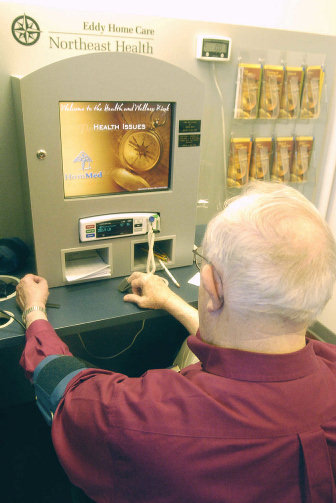
Getting a home blood pressure unit is a wonderful idea. It should not stress your husband, and it won’t contribute to his high blood pressure. It will give him readings that are obtained in normal surroundings, readings that can be more valuable than those taken in the doctor’s office.