
Students expand the cutting edge

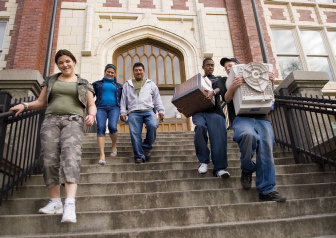
High school students Chris Dorsey and Adriana Gonzalez don’t share the same language.
Dorsey, a senior at Spokane’s Lewis and Clark High School, speaks English. Gonzalez, a freshman at Wahluke High School in Mattawa, Wash., speaks mostly Spanish at home.
But on Wednesday the teens shared the responsibility of helping low-income Hispanic children in the Spokane area gain access to computer technology.
Gonzalez was part of a group of 10 students from Mattawa – a tiny, mostly-Hispanic town located between Yakima and the Tri-Cities – who were invited to help students in LC’s computer repair class distribute refurbished computers to poor families.
Students from Wahluke will also take some of the refurbished computers back to their own community for distribution.
“It’s exciting to give something to people who need it,” said Gonzalez.
The career and technical education class at LC, called TEConnections, teaches students computer repair, customer service, communication and leadership. Part of the class includes having students repair recycled computers, and then organize a distribution for low-income families who do not have a computer in the home. The school district works with the Department of Social and Health Services to identify qualifying families with a student in Spokane Public Schools. The two agencies also work together to find usable computers for the program.
“We want students to have the tech skills but be better at communicating also,” said Mark Rhoades, who teaches the class at LC. “It’s a great service.”
In its second year, the class is also taught at Rogers High School, where students will distribute refurbished computers to low-income families. Havermale High School will also be starting a program after school.
The Spokane School District distributed more than 185 computers to Spokane area youth through the program during the 2005-06 school year, and this year hopes to distribute 500.
It’s been so successful that the LC students decided to share with their peers across the state – and bridge a cultural gap in the process.
The families invited to the distribution on Wednesday were mostly Hispanic, as were the students from Wahluke, a school of about 400 that is about 90 percent Hispanic.
Many of the students don’t have computers in their homes, including those who came to Spokane on Wednesday. Access to the Internet is also a challenge in Mattawa. It’s often too expensive for many of the migrant families living there. The program also offers coupons to families for discounted Internet service.
“This kind of program really does balance the playing field,” said Ed Allen, a career and technical education teacher from Wahluke.
According to the National Center for Education Statistics, students who have access to a home computer and the Internet do better with math, science and writing, and are 6 to 8 percent more likely to graduate from high school than those who do not own a computer.
“We just sort of make assumptions that every kid and every family has computers, and they don’t,” said Yvonne-Lopez Morton, chairwoman of the Washington Commission on Hispanic Affairs.
A lot of what kids do in school is driven by computers, with digital presentations and Internet research.
“Everything we do – essays, homework – is on a computer,” said Wahluke senior Bricela Martinez, 17. “Now I go to the library or the community center to get it done.”
Spokane student Dreisy Marquez-Garcia knows that feeling. She was the recipient of one of the Gateway computers on Wednesday.
“I’m going to write a lot of letters, too,” Marquez-Garcia said. Most of her family lives in Cuba.
“It’s good for her to have a computer; she can do a lot of work,” said her mother, Omeida Garcia. “It’s going to help her.”