
Shuttle Discovery lands in Florida
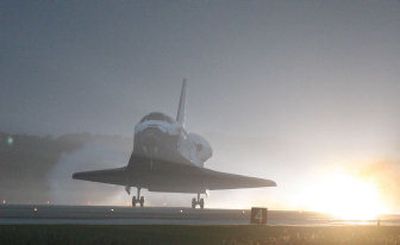
CAPE CANAVERAL, Fla. – A challenging and record-breaking mission behind them, seven space shuttle Discovery astronauts came back to Earth for a safe sunset landing on Friday afternoon, ending the year on a high note.
But a difficult string of five assembly missions beckons next year as astronauts work to complete the now half-finished construction of the $100 billion International Space Station before the shuttle program ends in 2010.
During their 13-day mission, Discovery’s astronauts rewired an electrical system on the space station and did an extra space walk to fix a balky solar array.
As sunlight faded Friday, the shuttle descended out of a gray late afternoon sky and landed at 5:32 p.m. local time.
For a time, it looked as though the threat of rain and clouds might force Discovery to land instead at Edwards Air Force Base in California or in White Sands, N.M.
But mission managers decided at the last minute that visibility was good and the rain far enough away so the seven astronauts could make it to the Kennedy Space Center.
Discovery brought home Commander Mark Polansky, pilot William Oefelein, mission specialists Robert Curbeam, Joan Higginbotham, Nicholas Patrick and Christer Fuglesang as well as space station astronaut Thomas Reiter.
From Houston, astronaut communicator Ken Ham welcomed the crew and congratulated them for what he called “probably the most complex assembly mission to date.”
From aboard the shuttle, Polansky responded: “We’ve got seven thrilled people right here. We are just really proud of the entire NASA team that put this together. I think it is going to be a great holiday,”
Ahead for astronauts next year are five of the 14 remaining space station construction missions. The first launch will be the shuttle Atlantis no earlier than mid-March.
The highlight of the Discovery mission was the wiring of a permanent electrical system for the space station. The station gets its power from large solar arrays that reach out like giant wings.
But one of the old arrays had to be retracted and put away before a new one could be rotated into place.
Like a 115-foot-long accordion whose individual folds refused to squeeze together, the solar array just hung there.
First it retracted part way, then jammed.
Nothing could un-stick it until Curbeam and Fuglesang went for an unplanned 6 1/2 -hour spacewalk Tuesday. They jiggled and coaxed the pesky array back into its box. For Curbeam, who’d made three previous spacewalks on this mission, the fourth was a NASA record.
There was another milestone.
“This particular mission actually put us over the halfway mark of getting the station complete,” NASA spokesman Bruce Buckingham said.
“We’ve carried up now more pieces than we’ve got left to take up.”