
British, Iraqi troops raid police station
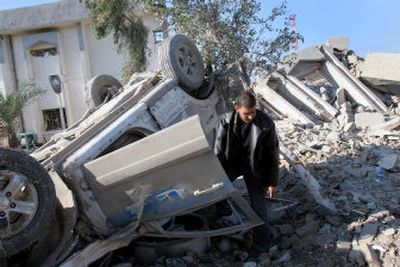
BAGHDAD, Iraq – About 1,000 British and Iraqi troops raided a police station in the southern city of Basra on Monday, killing seven gunmen and taking custody of more than 100 prisoners who were believed to be marked for execution by a renegade police unit.
Many of the prisoners at the Jamiat police station showed signs of torture, including cigarette and electrical burns, gunshot wounds in their legs and knees, and hands that had been crushed, said Capt. Tane Dunlop, a spokesman for British forces in Iraq. The station, a base for a squad known as the serious crimes unit, was later blown up by British forces.
The targeted unit “was in fact living up to its name,” Dunlop said. “It was conducting serious crimes rather than preventing it.”
Iraqi police forces are widely believed to be infiltrated by Shiite militias, but British military spokesmen said the rogue elements in this particular unit were involved in gang-like activity rather than sectarian killings. Still, the episode highlighted the challenges that U.S.-led coalition forces face in preparing the Iraqi army and police to secure their own country. Training Iraqi forces to do so is considered key to any U.S. troop withdrawal.
Maj. Charlie Burbridge, another British military spokesman, said the serious crimes unit had been suspected of illegal activity, including kidnappings, murders and attacks on British and other multinational forces.
The Iraqi army assumed responsibility for the prisoners, taking them to other facilities.
British troops have normally maintained a low profile in Basra. But they ended their raid on Monday by demolishing the base with explosives. The building, Dunlop said, had “a lot of bad history.”
Brig. Mohamad Humadi, Basra’s police commander, condemned the operation, saying the British military did not give him and other police in the city enough notice. Ali Humadi, an official with the Basra Security Committee, said his group had no prior knowledge of the operation.
But an Iraqi Defense Ministry spokesman, Muhammad al-Aaskari, said the raid was a coordinated effort among coalition and Iraqi forces and the country’s Interior Ministry.
Separately on Monday, U.S. and Iraqi officials announced that they had released a group of Iranians that American forces had detained last week on suspicion of planning attacks in Iraq. Three or four of those detained were Iranians who had diplomatic immunity, said a State Department spokesperson who spoke on condition of anonymity.
A White House spokesman, who also spoke on condition of anonymity, said only two Iranians had diplomatic immunity. He said the event could validate U.S. claims that Iran was meddling in the affairs of Iraq, but that the United States wanted to complete the investigation “before characterizing their activities.”
It was unclear Monday what evidence of planned attacks the U.S. had for detaining the Iranians. Also unclear was why the Iranians were released if they were seen as dangerous to U.S. interests in Iraq.
According to Iraqi officials, at least two of the detained Iranians were diplomats invited by Iraqi President Jalal Talabani. Their detentions occurred at a sensitive time for Iraq’s Shiite government as it tries to engage Tehran to play a role in reducing the insecurity inflicting Iraq.
Elsewhere in Iraq, five more American service members were killed, the U.S. military reported.
On Sunday, one Marine and one soldier died during fighting in the western Iraq province of Anbar. On Monday, a roadside bomb killed a soldier in a southern Baghdad neighborhood.
The military reported today the deaths of two more soldiers in a bomb explosion southwest of Baghdad on Monday. The announcment brings U.S. military deaths in Iraq to 2,974, one more than the number of deaths in the Sept. 11, 2001, attacks in the United States, according to an Associated Press count.
The Sept. 11 toll includes the 2,749 killed at the World Trade Center, 184 at the Pentagon and 40 passengers aboard United Flight 93.