
Right whale protections proposed
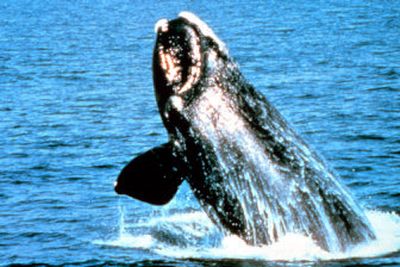
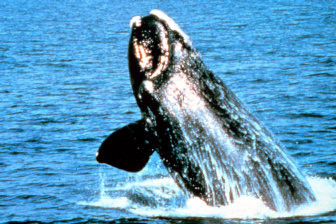
ANCHORAGE, Alaska – Having scored a win in getting more protection for polar bears, a conservation group is turning up the heat on the federal government to keep the North Pacific right whale from going extinct.
North Pacific right whales were thought to be headed toward certain extinction until a surprising number turned up a couple of summers ago in the Bering Sea. Despite that, it’s believed there are fewer than 100 of them off the coast of Alaska. Their future is precarious at best.
The whales are the most endangered whale in the world. A few hundred may still be left off the Russian coast.
Unlike polar bears, the plight of right whales is not surprising. They have been listed as endangered – meaning they are facing extinction – since 1973.
Pacific right whales were hunted nearly to extinction in the 1840s, when 15,000 were killed in a single decade, said Brendan Cummings, ocean program director for the Arizona-based Center for Biological Diversity, one of three groups that led the legal fight to get polar bears listed under the federal Endangered Species Act.
The Bush administration proposed Wednesday that polar bears be listed as “threatened” because of melting Arctic sea ice related to global climate change. A listing of threatened is one step lower than endangered. It means the species is likely to face extinction in the foreseeable future.
On the same day, the conservation group scored another success, getting the Bush administration to propose that the North Pacific right whale get its own endangered listing, apart from right whales in the North Atlantic. The proposal must be finalized in a year.
Although scientists view the North Pacific and North Atlantic right whales as genetically distinct, they are listed as the same species. A 1991 recovery plan for right whales makes scant reference to whales in the North Pacific, instead focusing on the North Atlantic where there are believed to be about 350, Cummings said.
The separate listing proposal is important because it will draw attention to the few right whales left in the Pacific, Cummings said Thursday.
“It is a statement that it is not acceptable for right whales in the Pacific to go extinct,” he said.
The separate listing also will bring increased scrutiny to any proposals for oil and gas development in the area where the whales have repeatedly been spotted.
“We have the most endangered whale in the world and a proposal to open up its most important habitat to oil and gas development,” Cummings said.
Just this year, the center was successful in getting the National Marine Fisheries Service to designate almost 36,000 square miles of the Bering Sea as critical habitat for the whales. Some of that designated habitat is within the North Aleutian Basin, an area that the Bush administration has proposed to open for oil and gas leasing, Cummings said.
The push for the separate listing goes back to August 2005, when the conservation group filed a petition with the fisheries service requesting the separate listing. In January, the agency agreed that a separate listing may be warranted but then missed an Aug. 19 deadline to decide. Last week, the center filed a lawsuit over the missed deadline.
The new proposed rule for the separate listing was published Wednesday. It must be finalized in a year. The final rule would trigger a requirement that a separate recovery plan be developed specifically for North Pacific right whales.
A few North Pacific right whales have been spotted in the Bering Sea each year from 1996 to 2002, but they were all males. Then, scientists a few years ago spotted a cow and a calf. It was only the second time in about 100 years that a North Pacific right whale calf had been spotted.
In the summer of 2004, scientists looking for humpback whales in the Bering Sea got a big surprise. They counted 25 right whales – twice as many than had previously been spotted.