
Dow lower in last day of record year

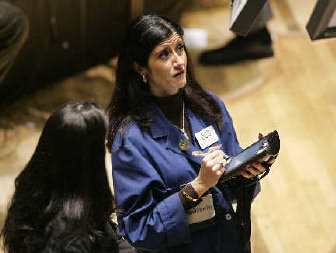
Wall Street slipped lower Friday, closing out a year that will be remembered for the stock market’s great comeback — a year-end rally that pushed the Dow Jones industrials past 12,000 for the first time.
By all accounts, 2006 ended up a very good year for stocks as bullish investors bounced back from a slumping housing market and the Federal Reserve’s two-year campaign of interest rate hikes. The markets approached record levels in the spring, pulled back sharply in the summer, but found a clear direction in the fall to send the major indexes to multi-year highs.
Blue chips were the standouts of 2006. The Dow Jones industrial average, the index of 30 of the nation’s biggest companies, hit record levels dozens of times since achieving its first close above 12,000 on Oct. 19; it traded as high as 12,529.87 before dipping to its close for the year.
This was the best year for the stock market since 2003, when Wall Street staged a massive recovery from levels sideswiped by a bear market. But 2006 will really be remembered for the market’s soaring to heights not seen since the height of the dot-com era — this time, however, Wall Street advanced cautiously, not recklessly.
The rally was fed by investors’ growing belief that the economy has withstood well the Fed’s rate hikes and the impact of record high oil prices. And some analysts expect the advance to continue.
“The stock market is correct in its judgment that we are probably only in the fifth or sixth inning of the game, and that this (economic) expansion may even go into extra innings,” said Stuart Schweitzer, global markets strategist for JPMorgan Asset & Wealth Management. “This was a barn-burner of a year, and I expect reasonably solid results over the course of 2007.”
On Friday, the Dow fell 38.37, or 0.31 percent, to 12,463.15.
Broader stock indicators also slipped. The Standard & Poor’s 500 index fell 6.43, or 0.45 percent, to 1,418.30, and the Nasdaq composite index closed down 10.28, or 0.42 percent, to 2,415.29.
The major indexes posted healthy gains for the year, with the Dow Jones industrials rising 16.29 percent, the S&P 500 adding 13.62 percent, and the Nasdaq up 9.52 percent. That’s the best showing since 2003, when the Dow closed up 25.3 percent, the Nasdaq rose 50 percent, and the S&P 500 gained 26.4 percent — but those gains were the beginning of the market’s recovery from the trough of three straight losing years.
It wasn’t just the stock markets that made significant gains in 2006.
The bond market moved in lockstep with stocks — a rare event on Wall Street. Investors bought into equities because of a strong economy and robust corporate confidence. Meanwhile, typically more conservative bond investors used the fixed-income market as a hedge for a possible recession and interest rate cuts.
This year was also a bit of a rule bender for Treasuries. Yields on long-term Treasury notes and bonds were lower than for short-term Treasury bills. Junk bonds were in such demand that their yields were on almost on parity with those of investment-grade bonds.
Bonds slipped further in Friday’s session, with the yield on the benchmark 10-year Treasury rising to 4.71 percent from 4.69 percent on Thursday. The yield stood at 4.37 percent on the first day of trading this year, and was over 5 percent just a few months ago.
The dollar, which has struggled against the euro and other major currencies, was mixed on Friday. The U.S. currency lost support in 2006 after the Fed stopped raising rates on Aug. 8 and kept them unchanged in its past three meetings.
And gold prices continued their rally; investors have sent precious metals sharply higher, viewing commodities like gold and silver as safe-haven investments instead of the greenback.
Advancing issues outnumbered decliners by about 2 to 1 on the New York Stock Exchange, where volume came to 1.2 billion shares, compared to 1.32 billion on Thursday.
The Russell 2000 index of smaller companies dipped 6.82, or 0.86 percent, to 787.66. For the year, the Russell rose 17 percent.
Overseas markets also soared to multi-year highs in 2006. Japan’s Nikkei stock average closed up 0.01 percent on Friday. Britain’s FTSE 100 was down 0.32 percent, Germany’s DAX index fell 0.23 percent, and France’s CAC-40 was up 0.15 percent.