
Former president refused a hood

BAGHDAD, Iraq – Clutching a Quran and refusing a hood, Saddam Hussein went to the gallows before sunrise Saturday, executed by vengeful countrymen after a quarter-century of remorseless brutality that killed countless thousands and led Iraq into disastrous wars against the United States and Iran.
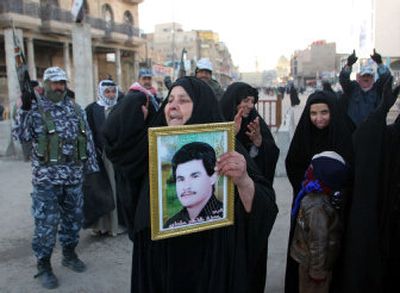
In Baghdad’s Shiite enclave of Sadr City, people danced in the streets while others fired guns in the air to celebrate the former dictator’s death. The government did not impose a round-the-clock curfew as it did last month when Saddam was convicted to thwart any surge in retaliatory violence.
It was a grim end for the 69-year-old leader who had vexed three U.S. presidents. Despite his ouster, Washington, D.C., its allies and the new Iraqi leaders remain mired in a fight to quell a stubborn insurgency by Saddam loyalists and a vicious sectarian conflict.
President Bush called Saddam’s execution “the kind of justice he denied the victims of his brutal regime.”
Ali Hamza, a 30-year-old university professor, said he went outside to shoot his gun into the air after he heard the news.
“Now all the victims’ families will be happy because Saddam got his just sentence,” said Hamza, who lives in Diwaniyah, a Shiite town 80 miles south of Baghdad.
“We are looking for a new page of history despite the tragedy of the past,” said Saif Ibrahim, a 26-year-old Baghdad resident.
State-run Iraqiya television initially reported that Saddam’s half-brother Barzan Ibrahim and Awad Hamed al-Bandar, the former chief justice of the Revolutionary Court, also were hanged. However, three officials later said only Saddam was executed.
Sami al-Askari, the political adviser of Prime Minister Nouri al-Maliki, told the Associated Press that Saddam struggled when he was taken from his cell in an American military prison but was composed in his last moments.
He said Saddam was clad completely in black, with a jacket, trousers, hat and shoes, rather than prison garb.
Shortly before the execution, Saddam’s hat was removed and Saddam was asked if he wanted to say something, al-Askari said.
“No I don’t want to,” al-Askari, who was present at the execution, quoted Saddam as saying. Saddam repeated a prayer after a Sunni Muslim cleric who was present.
“Saddam later was taken to the gallows and refused to have his head covered with a hood,” al-Askari said. “Before the rope was put around his neck, Saddam shouted: ‘God is great. The nation will be victorious and Palestine is Arab.’ “
Saddam was executed at a former military intelligence headquarters in Baghdad’s Shiite neighborhood of Kazimiyah, al-Askari said.
Al-Askari said the government had not decided what to do with Saddam’s body.
Photographs and video footage were taken, said National Security adviser Mouwafak al-Rubaie.
“He did not ask for anything. He was carrying a Quran and said: ‘I want this Quran to be given to this person,’ a man he called Bander,” he said. Al-Rubaie said he did not know who Bander was.
“Saddam was treated with respect when he was alive and after his death,” al-Rubaie said. “Saddam’s execution was 100 percent Iraqi and the American side did not interfere.”
The execution came 56 days after a court convicted Saddam and sentenced him to death for his role in the killings of 148 Shiite Muslims from a town where assassins tried to kill the dictator in 1982. Iraq’s highest court rejected Saddam’s appeal Monday and ordered him executed within 30 days.
A U.S. judge Friday refused to stop Saddam’s execution, rejecting a last-minute court challenge.
U.S. troops cheered as news of Saddam’s execution appeared on television at the mess hall at Forward Operating Base Loyalty in eastern Baghdad. But some soldiers expressed doubt that Saddam’s death would be a significant turning point for Iraq.
“First it was weapons of mass destruction. Then when there were none, it was that we had to find Saddam. We did that, but then it was that we had to put him on trial,” said Spc. Thomas Sheck, 25, of Philadelphia, who is on his second tour in Iraq. “So now, what will be the next story they tell us to keep us over here?”
Sgt. Elston Miramonte, 25, of Monticello, N.Y., said Saddam got what he deserved.
“All the people that he killed, did they deserve to die? He had a fair trial, and it was time to execute him,” he said.
In a farewell message to Iraqis posted Wednesday on the Internet, Saddam said he was giving his life for his country as part of the struggle against the U.S.
One of Saddam’s lawyers, Issam Ghazzawi, said the letter was written by Saddam on Nov. 5, the day he was convicted by an Iraqi tribunal in the Dujail killings.
The message called on Iraqis to put aside the sectarian hatred that has bloodied their nation for a year and voiced support for the Sunni Arab-dominated insurgency against U.S.-led forces, saying: “Long live jihad and the mujahedeen.”
Saddam urged Iraqis to rely on God’s help in fighting “against the unjust nations” that ousted his regime.