
LC grad helping out after Katrina disaster
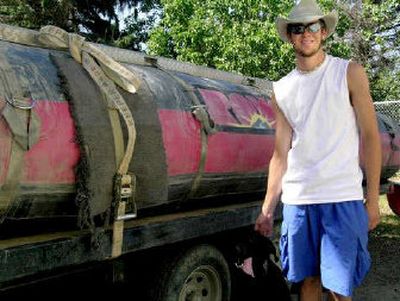
Hurricane Katrina hit the Gulf Coast just days after Billy Cotton signed on with AmeriCorps St. Louis, and the 19-year-old Coeur d’Alene man soon found himself knee-deep in the Mississippi mud and surrounded by strangers.
“We had to build relationships while we were in the middle of the devastation,” says Cotton, a 2005 Lake City High School graduate. “Disasters bring out the best and the worst in people.”
It was with the best intentions that Cotton signed on with AmeriCorps. He wanted to gain experience during his “gap year” before attending college in the fall.
“I was looking for something to do for my gap year that would give me training for later,” he says by phone from St. Louis.
With Katrina, Cotton soon found himself in Biloxi, Miss., helping to muck out houses and coordinate other volunteers.
“In Pass Christian, Mississippi, we vowed to open their school within two weeks … and we did,” Cotton says. “Everything had been contaminated with floodwater. A 25-foot wave had washed over the town, and the elementary school was the only school still standing. It’s an old brick building, but it held up against the storm.”
Cotton says his experiences growing up in Coeur d’Alene helped him in the disaster zone.
“My parents trained me well for hard labor,” he says. “They helped me increase my stamina and taught me how to use a chain saw.”
Cotton’s mom, Karen, sees it differently.
“Bill’s extracurricular activities, rather than school, are what prepared him for this AmeriCorps experience: Boy Scouts and his Eagle Scout project, Silver Mountain volunteer ski patrol, Sweyolaken Camp counselor, scuba diving, snowboarding, snow-caving, traveling, etc.,” she says. “That kid would rather be outdoors in the most inclement weather than anywhere else. All of these experiences added to his feeling of being needed and making a difference.”
AmeriCorps St. Louis has a contract with the Federal Emergency Management Agency to keep 15 members in the hurricane disaster zone for one year. Cotton lives in an apartment in St. Louis with his team members and is given a stipend for rent, food and transportation. In rotating shifts, the volunteers travel in vans or pickups to areas affected by the hurricane. “The most interesting part is working with the people in the communities,” Cotton says. “They open up their homes to us, even if all they have is half a building. They make us lunch, bring us iced tea. They’re so grateful we’re there.”
When he’s not working on disaster relief, Cotton is involved in conservation projects, such as creating fire lines, doing controlled burns, removing invasive plant species and “just generally trying to bring back the beauty of Missouri,” he says.
Each year more than 70,000 Americans volunteer with AmeriCorps, working with more than 3,000 nonprofits, public agencies and faith-based and community organizations in areas of education, public safety, health and the environment. An education award of just under $5,000 is given to each full-time member who completes a year of service. The money can be used to pay for college, graduate school, or to repay student loans.
Cotton is planning to use his education award to finance a year at North Idaho College before attending either the University of Montana in Missoula or a community college in central Wyoming to study environmental science and emergency response for wildland firefighting. AmeriCorps is providing him with firefighting training and practice this winter, which he plans to put to use this summer in the Western states.
Cotton is enthusiastic about AmeriCorps even though the experience has thrust him into a disaster zone.
“I’d recommend AmeriCorps to anybody,” he says. “It’s an awesome program. We’re well-supported, well-trained, and respected. It’s opened up my eyes to the world, and hey – it always looks good on a resume!”