
Protests spread to Lebanon
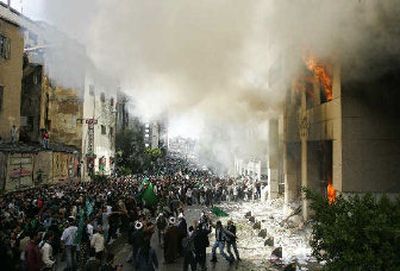
BEIRUT, Lebanon – Muslim rage over caricatures of the prophet Muhammad grew increasingly violent Sunday as thousands of rampaging protesters – undaunted by tear gas and water cannons – torched the Danish mission and ransacked a Christian neighborhood. At least one person reportedly died and about 200 were detained, officials said.
Muslim clerics denounced the violence, with some wading into the mobs trying to stop them. Copenhagen ordered Danes to leave the country or stay indoors in the second day of attacks on its diplomatic outposts in the Middle East.
In Beirut, a day after violent protests in neighboring Syria, the thousands-strong crowd broke through a cordon of troops and police that had encircled the embassy. Security forces fired tear gas and loosed their weapons into the air to stop the onslaught.
The protesters, armed with stones and sticks, seized fire engines, overturned police vehicles and garbage containers for use as barricades, damaged cars and threw stones at a Maronite Catholic church in the wealthy Ashrafieh area – a Christian neighborhood where the Danish Embassy is located.
Flames and smoke billowed from the 10-story building, which also houses the Austrian Embassy and the residence of Slovakia’s consul.
Protesters waved green and black Islamic flags from the broken windows of the building and tossed papers and filing cabinets outside.
Witnesses said one protester, apparently overcome by smoke, jumped from a window of the embassy and was rushed unconscious to hospital. Security officials said he died.
Thirty people were injured, half of them members of the security forces, officials said, making it the most violent in a string of demonstrations across the Muslim world. All the injuries were from beatings and stones.
Prime Minister Fuad Saniora said that about 200 people were detained, and police said they included 76 Syrians, 35 Palestinians and 38 Lebanese.
The first apparent victim of the political fallout from the violence was Interior Minister Hassan Sabei, who submitted his resignation during an emergency Cabinet meeting chaired by President Emile Lahoud. It was not immediately clear if the resignation was accepted.
The United States accused the Syrian government of backing the protests in Lebanon and Syria.
The Danish Foreign Ministry urged Danes to leave Lebanon quickly. The Syrian state-run daily newspaper Al-Thawra said Denmark was to blame because its government had not apologized for the September publication of the caricatures in the Jyllands-Posten.
The drawings have since been republished in several European and New Zealand newspapers as a statement on behalf of a free press.
Islamic law is interpreted to forbid any depictions of the Prophet Muhammad for fear they could lead to idolatry.
Denmark’s Prime Minister Anders Fogh Rasmussen has said he disapproves of the caricatures and any attacks on religion, but insisted he cannot apologize on behalf of his country’s independent press.
A Lebanese security official, who spoke on condition of anonymity because he was not allowed to speak to the press, said Danish diplomats had evacuated the mission in Beirut two days earlier, anticipating the protests.