
recycling with rik
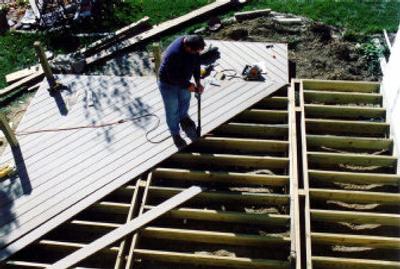
How quickly we transition from “Deck the halls” to “Deck the house.”
“About this time of year, people get cabin fever,” says James Elpers, lumber department supervisor at the Liberty Lake Home Depot store. By early February, he says, homeowners begin planning and pricing outdoor projects, like decks, and in March and April use their tax returns to purchase materials.
Traditionally, cedar and redwood have been favorites for deck construction. But because it’s easy to use and maintain, composite decking is gaining popularity for both new and replacement decks.
Composite decking is made from post-consumer and post-industrial plastics and wood waste. The recovered and recycled wood fiber may come from furniture and cabinet making operations, or sawmills. However, some composite products use peanut shells or rice hulls.
The plastic component in composite decking can come from recycled bottles and milk jugs, but some manufacturers incorporate shrink-wrap and plastic garbage bags. Some use a combination of new and post-consumer plastics.
After the plastics and wood fibers are blended, color and UV stabilizers (and sometimes preservatives) are added to the mix and it’s extruded into planks. The planks, usually with a wood-grain look on at least one side, come in 8- to 20-foot lengths and are either solid or hollow core. Solid decking must be screwed down from the top, whereas hollow core uses a hidden fastener system. Also, hollow core has been engineered to promote air flow for cooling purposes, which reduces expansion and contraction. The space inside also allows electrical wiring to be concealed there.
Composite decking is not plastic lumber. Plastic lumber does not contain wood fiber, so it can be used structurally; i.e., it has load-bearing capacity. Composite decking, on the other hand, has been designed specifically for decks, porches, dock planking, pool decks and boardwalks. Most manufacturers offer compatible composite posts, post caps and skirts, balusters, fascia boards, stairs and bench seats, even planter boxes.
Although composite decking materials cost more than wood decking by 20 to 30 percent, composite manufacturers say that over the lifetime of the deck, lower maintenance costs makes theirs less expensive.
“I’m an old carpenter from the ‘70’s – I love wood,” says Bill Nixon, customer service rep at Ziegler’s Building Materials on East Sprague. “But my next deck will be a composite.” Nixon says he’s found wood decks need maintenance about every two years and he’s tired of all the sanding, bleaching, staining and resealing. Maintenance required on a composite deck, he says, is low – just washing it with soap and water to clean off dust and pollen in order to prevent mold and mildew.
Manufacturers say, depending on the amount of sunlight a deck receives, some color-shifting (fading) will occur, usually over a two-month to yearlong period. So, to determine what a particular deck will eventually look like, you may want ask to see one that’s already been installed.