
Schooled in history
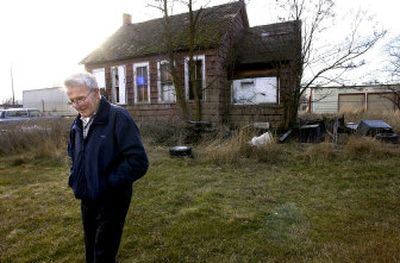
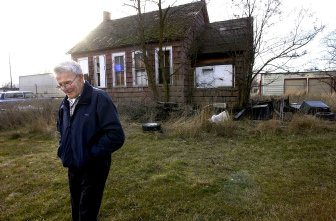
There was a big woodstove but no plumbing when Phyllis Sullivan and her siblings learned the three R’s from the one teacher at the Lone Fir School.
“She heated water on the stove for us to wash our hands at lunchtime,” Sullivan said.
She spent part of seventh grade at the school in 1937 after moving to the Saltese area in southeast Spokane Valley. The school, built in 1895, was already 42 years old.
“It’s just a little one-room school, you know,” said her older sister, Lurene Pirello, whose daughter attended kindergarten in the building after it was moved in the late 1940s behind Vera Grade School near Sprague and Progress, where it stands today.
Some 20 rural schools once dotted the Spokane Valley when agriculture began to thrive at the turn of the 20th century.
Preservationists would like to make sure this one doesn’t disappear.
“We think it is our responsibility to preserve the last remaining one-room schoolhouse,” said Jayne Singleton, of the Spokane Valley Heritage Museum. “There are very few old buildings in the Valley left. … Most of the history has been torn down.”
The museum plans to haul the school two miles to the museum or to another location as early as this summer and restore it to the educational center it used to be.
The museum has already gathered a large bell and other supplies for the school, and Singleton envisions Valley schoolchildren spending a day there learning penmanship, spelling and other subjects, just as students did years ago.
“Everybody did their recitation at their seat, and everybody else listened in on it,” Sullivan said.
Children in other grades were supposed to study while the teacher, Mrs. Wright, worked with students from one grade.
“It really was kind of a unique situation because you could pick up something from the succeeding class, and the transition really was smoother,” said Buell Hollister, who attended Lone Fir with Pirello and other siblings.
Hollister likes to contrast the school with the cultural trend toward increasingly larger institutions, which he said aren’t necessarily better.
Farmers would provide the wood for the stove, he said, and the school’s 15 or 20 students would help keep the room tidy.
“It was a pretty close-knit little community,” Hollister said.
‘Anything is movable’
Preserving some of the experiences of families like Hollister’s is part of why the museum set up shop two years ago in the old Opportunity Township Hall.
The museum has since established an array of exhibits unique to the Spokane Valley and is preparing to host a Smithsonian exhibit in March.
“We’re undaunted by the task of moving a one-room schoolhouse,” Singleton said.
Fund raising and lining up volunteers to help with the renovation will begin soon, she said.
The price of the move and where the school will be placed have yet to be determined.
An area businessman who specializes in moving buildings – including a similar schoolhouse trucked from Newport to the Eastern Washington University campus in Cheney – assured Singleton it can be done.
“He said to me, ‘Jayne, anything is movable,’ ” Singleton said.
The Lone Fir schoolhouse currently sits on the Bell RV property on Sprague and is used for storage.
“We just bought it (the property), and it was here already,” said Susan Bishop, whose family is donating the building.
From time to time, she said, RV customers recall their time as youngsters in the building.
“One of them rode to school on a horse,” she said.