
The Buddhist way

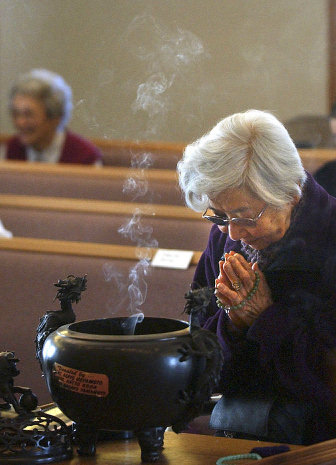
Immersed in the rising incense smoke, Marcelline Burdett bowed before the Buddha.
In gratitude and reverence, the 87-year-old sprinkled a pinch of incense onto the embers, bowing once more while placing her palms together, her prayer beads encircling her hands.
Through this incense offering called Oshoko, Burdett is often reminded of the transitory nature of all existence – that change is an inevitable part of life.
Since she helped establish the Spokane Buddhist Temple more than 60 years ago, Burdett has definitely embraced that philosophy of impermanence.
What began as a small, close-knit congregation of Japanese Americans has now evolved into a diverse community where Asian Americans worship along with people of all backgrounds.
The change at the Spokane Buddhist Temple mirrors the growth of Buddhism worldwide. Originally spread from Asia, Buddhism is now considered the fourth-largest religion in the United States, with an estimated 1.5 million adherents. In addition to the Spokane Buddhist Temple, the Inland Northwest has become home to at least five other Buddhist congregations, including a monastery in Newport.
Beginning Friday, members of the Spokane Buddhist Temple will welcome more than 400 Buddhists to town for the 59th annual Northwest Buddhist Convention.
Participants include members of the Buddhist Churches of America, which practices one of the faith’s major traditions, known as Jodo Shinshu Shin. According to organizers, this is the first time in 20 years that Spokane will host such a significant Buddhist gathering.
The theme of the convention – “Where the Flower and the Rock Meet” – reflects the changes at the Spokane Buddhist Temple and other congregations throughout the United States.
“There is an old saying that bringing Buddhism to a new culture is like bringing a flower and a rock together,” wrote Sakyong Mipham Rinpoche, world renowned Buddhist teacher and head of the Shambhala Buddhist lineage. “The flower represents the potential for compassion and wisdom, clarity and joy to blossom in our life. The rock represents the solidity of a bewildered mind. If we want the flower to take root and grow, we have to work to create the right conditions.”
The changes at the Spokane Buddhist Temple didn’t happen overnight, said Burdett. Nor were they always easy.
But opening their temple’s doors to hakujin or non-Japanese became a necessity – not only to share their faith, but also to survive.
“The temple could have died out,” said Burdett. “But newcomers came and kept it alive.”
The Spokane Buddhist Temple began after the internment camps of World War II, when Burdett and five other Japanese Americans originally from the Seattle area followed the Rev. Eiyu Terao to Spokane. Their first Sunday services took place in a rented apartment on Cowley Street until they were able to buy a house about a half block away.
The temple provided more than just religion, recalled Burdett, one of two original members still living. It became a place of emotional support, especially as they endured the racism inflicted upon many Japanese Americans at the time.
Membership flourished. In 1965, the congregation needed a bigger home so it bought its current building at 927 S. Perry St.
After decades of conducting services only in Japanese, the temple decided to add translations in English so spouses who couldn’t speak the language could take part.
“That made me feel welcome,” said Pat Omine, who joined the temple 31 years ago when she married Van “Harry” Omine, who has since passed away. “It helps to be able to understand. … Buddhism, after all, isn’t just for Japanese.”
On a recent Sunday, more than half of the roughly 40 people who attended the temple service didn’t appear to be of Japanese origin. While most seemed to be in their 40s and 50s, the crowd included several families with young children.
In the small, chapel-like room known as the temple hall or hondo, people sat in pews before an elaborate golden altar with a statue of the Buddha at its center.
“Na Man Da Bu,” they later chanted, using words from the sutras, or Buddhist scriptural text. “I take refuge in Amida Buddha.”
The sutras they sing are translated from the ancient language of Pali to Chinese, although people seem to pronounce them with a Japanese accent, explained Christine Marr, the temple board president. They’re found in the violet-colored “Shin Buddhist Service Book,” which is written in both Japanese and English, along with a transliteration of the sutras.
While a few workshops are still conducted in Japanese, English has become the primary language during services and at the children’s Dharma School.
With the use of English and the growth in the number of converts, the temple has become more Westernized – a practice that reflects the pragmatism of Jodo Shinshu Buddhism, which began in 12th century Japan to serve the interests of the everyday working people, according to Marr.
Members’ willingness to open their doors has enhanced the Spokane Buddhist Temple’s diversity, said Marr, who was raised as a Mormon but became Buddhist when she was a teenager.
“The temple has its Japanese roots but people of all ethnic backgrounds are comfortable coming in,” she said.
“This is a way for us to honor our past as we move toward the future.”