
Explorer aims to stay atop SUV field
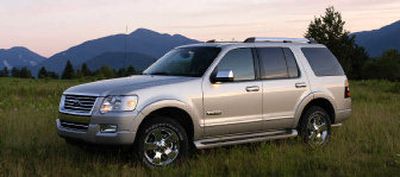
The best off-road adventures take place on uncertain footing.
Grow inattentive or indecisive on a treacherous trail and you’ll pay the price. Risk and reward, those eternal companions, prevail.
Ford’s current predicament is similar. After years of easy cruising atop the SUV heap, the earth beneath its tires has shifted.
Following its debut in 1991, Ford’s midsize Explorer outsold all other SUVs for 15 consecutive years, shipping more than 5.5 million units.
Then came the car-based crossovers and $2.50-a-gallon gas and, like a rig riding a crumbling trail edge, Explorer’s solid footing seemed less secure.
For 2006, Ford positions Explorer not as one-size-all solution, but as half of a two-tier SUV strategy.
For customers who desire the car-like ride and handling of a crossover, Ford now offers the Freestyle. For the rest, there is the Explorer.
Stripped of its need to be all things to all people, the Explorer is now free to offer more of what buyers of traditional SUVs want, including an all-new, more powerful and more fuel-efficient optional V-8, which increases the payload to more than 1,500 pounds and the towing capacity to 7,300 pounds.
Other improvements are important, too, and the new Explorer is quieter, safer and better equipped.
The ‘06 Explorer also costs less, by an average of $1,750, model-to-model, than last year. Be forewarned, though: Dealers may not have as much latitude to dicker as in years past.
Many folks who buy traditional, truck-based SUVs plan to tow a boat or a trailer, so the healthy application of power is critical. And, since no one opposes saving a buck, fuel economy counts, too.
The new 4.6-liter single overhead-cam V-8 uses the same variable valve timing and three-valve cylinder heads found in the 4.6-liter Mustang GT and 5.4-liter F-150 engines. In the Explorer, it makes 292 horsepower — 53 more than the previous, two-valve engine — and 300 foot-pounds of torque.
The eight is mated with an all-new, first-in-class six-speed automatic that’s geared with long legs to allow the engine to spend more of its time in the power band’s sweet spot, whether that’s peak power for acceleration or peak efficiency for fuel economy.
No eight-cylinder SUV will ever meet a filling station it didn’t like, but the new eight earns an impressive EPA rating of 14 city/20 highway.
The base, 4.0-liter V-6 makes 210 hp and 254-pound-feet. The EPA rates it at 15 city/21 highway and awards it ultra-low emissions status.
The Explorer is available in XLS (from $27,175-2WD/$29,400-4WD, including destination); XLT ($28,879/31,095), Eddie Bauer ($30,845/33,070); and Limited ($33,160/35,385) trim levels.
The eight is available on all trims but XLS and adds nearly $2,000 to the cost of freight. Four-bys are equipped with a three-mode Control Trac system that includes set-and-forget 4x4 auto, 4x4 High and, for those treacherous conditions, 4x4 Low.
Standard equipment on all Explorers includes air conditioning, cruise control, an MP3-compatible CD player, keyless entry and power mirrors, windows and door locks.
The newly expanded list of safety gear includes four-wheel disc antilock brakes with electronic brake-force distribution and brake assist, side-impact airbags and a stability and roll stability control system that uses a gyro sensor to anticipate a rollover and to adjust power distribution and braking to help prevent it.
Interior upgrades include not only more pleasing materials and larger gauges but also arm rests and door trim designed to help cushion the abdomen and lower torso during a side impact. A 4-inch-thick foam block installed between the front-door panels helps reduce the force of a side impact on an occupant’s hips.
Ford says the increased use of sound-deadening insulation makes its third-row seat quieter than most competitors’ second rows and better even than some front rows. More subjectively, the improvements are obvious to the naked ear; this is a quiet cabin.
That third row, by the way, is barely habitable by two adults and cuts into total cargo capacity, so order it judiciously.
While there have been modest revisions to the sheet metal more important changes occur underneath, where an all-new frame is 63-percent more resistant to bending and 55-percent more resistant to twisting.
A stiffer frame allows more refined tuning of the suspension, braking and steering systems; consequently, the ‘06 Explorer has a smoother ride, better road feel, crisper handling and improved steering response.
A more solid foundation also reduces squeaks and rattles; in a big, upright vehicle like the Explorer, the benefits of that improvement can’t be overstated.
Thanks largely to its rear independent suspension – true off-road vehicles traditionally use solid rear axles — the Explorer’s ride and handling package has always been among the SUV world’s best, and the ‘06 sets a new standard.
Body control is terrific and although it’s firmer than many, the ride is smooth and compliant, even over badly broken road surfaces.
Explorer earned its ride to the top of the hill and though the footing up there is no longer as sure as it once was, improvements keep the rig at the top of its game.