
Smoking ban meets defiant crowd
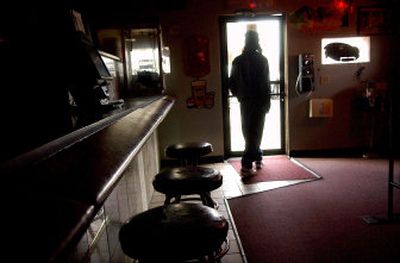
Two months after Washington state’s clean indoor air law took effect, there appears to be confusion among some bar owners and patrons about what the smoking ban means, how long it can last and what can be done to circumvent it.
Nowhere in Spokane is consternation over Initiative 901 more evident than in Hillyard, where the ban has aggravated competition among four bars within a two-block radius for a working-class clientele to whom drinking and smoking have always gone hand in hand.
Complicating matters is the fact that the unfunded law approved by voters in November saddles the Spokane Regional Health District and its three-member smoking enforcement team with the task of regulating the entire county.
“If government is going to make rules, then it needs to enforce them,” said City Councilman Bob Apple, owner of the Comet, which until recently was the only one of the four bars not allowing patrons to smoke in violation of the law.
That is putting him at a competitive disadvantage with the Alaskan Lounge, the Capitol and Entertainment Central, which have been allowing customers to smoke, Apple said.
Health district inspectors paid a surprise visit to all four bars on Feb. 2 and found two of them in violation. The inspectors, acting on a tip that some of the establishments were renting ashtrays to patrons as a means of raising money to pay $100 smoking tickets, issued warnings to the Capitol and Entertainment Central.
The inspectors visited the Capitol first, and its customers immediately called the other bars to warn them, said Patty Breithaupt, who has been running Entertainment Central while she negotiates its purchase. The only reason she was caught, she said, is because a deaf customer came in and lit up while the inspectors were there.
Breithaupt said she kept one ashtray behind the bar, and smoking customers could use it all night for $2. The idea of renting ashtrays began at a Spokane Valley truck stop, Breithaupt said, and now others are doing it.
“People are willing to pay the fines,” she said in an interview. “I’ve got $500 in a jar to pay for tickets.”
The health district would like to snuff this enterprise along with the butts. Even if bars raise enough money to pay the $100 tickets, plus the $225 reinspection fee, on the third violation the owner is going to court. Three area bars – the Lone Cactus Saloon in Mead, the Yardley Bar & Grill in Spokane Valley and G. Litzee’s Tavern in Greenacres – are already on their way.
“They are breaking the law, and it’s unfair to those who are obeying,” said Maggie Merrill of the health district’s tobacco enforcement section. “They’re only hurting the other bars that are in the same financial state as they are.”
Apple couldn’t agree more.
“They should be out writing tickets,” he said of inspectors. “If they were out there citing people, they could be paying for their salaries.” Twenty tickets a day would allow the district to hire more inspectors, Apple said. “The government isn’t doing its job, as usual.”
Health district spokeswoman Julie Graham said the inspectors are administering the law fairly and consistently by acting on complaints from patrons, bar employees and competitors. Food inspectors are also helping out during the day. But actually catching someone smoking in bars at night is no easy matter. The tobacco enforcement team is easily recognized, and violators are on their guard.
One night last week, customers openly smoked at both Entertainment Central and the Alaskan, where patrons were offered empty beer bottles to use as ashtrays.
“There are thousands of restaurants and bars, and we wouldn’t have enough staff if we had a hundred inspectors,” Graham said. But she added that the inspectors will catch up with violators eventually.
Dr. Kim Thorburn, the county health officer, said the fees are in no way covering the cost of the tobacco enforcement program, which is the responsibility of only local health districts. So far, the Washington State Liquor Control Board is not determining smoking as a violation of liquor law, although Thorburn believes that legal misconduct of any kind could be interpreted as a violation.
It doesn’t help that many bar owners and patrons believe legislation is pending that would grant waivers to businesses that can prove a 10 percent loss in revenue. They also hold out hope that lawmakers will allow them ventilated smoking rooms. Not even industry lobbyists believe either is going to happen anytime soon, if at all.
Back at Entertainment Central, Breithaupt recounted a Saturday night a couple of weeks after the smoking ban went into effect on Dec. 8. She paid $600 for a band, and only three customers showed up.
“Everyone was over at the Alaskan smoking,” she said.
So one of her loyal customers walked through the competitor’s bar with a sign that read, “Smoking at Entertainment Central.” Within 10 minutes, Breithaupt said, her place was full.
“Up here in Hillyard,” she said, “if there’s no smoking, you can’t make it.”
She blamed Apple for turning her in along with the other smoking bars, a charge he denied. She believes inspectors aren’t really interested in little bars like hers, a claim the health district denied. She and others hope this will all blow over and business will continue as usual, a dream that ignores reality.
No state indoor smoking ban has ever been overturned by a court, and most people like it that way.
In 2002, four years after California’s smoke-free bar law took effect, two public opinion polls showed 75 percent of bar owners and employees and 80 percent of patrons preferred smoke-free environments.
In 2005, a study using tax revenue data from four years before and four years after the law took effect found that bars and restaurants actually increased revenues.
“If there was any loss of smokers, it was more than made up by nonsmokers,” said Colleen Stevens, who has worked in tobacco control for the California Department of Health Services since 1990.
“People go to bars for the socializing effect,” she said, citing studies that show more people go to bars, and stay longer, when they are smoke-free. “Even smokers don’t want people smoking around them. They don’t want to smell like smoke.
“As time goes on, there will be fewer and fewer places not following the law, and it will be easier and easier for enforcement actions to take place,” Stevens said. “It is a law that is good for business and will be good for the health of Washington. Once they get used to the law, they will love it.”