
Iran wants Rice to apologize
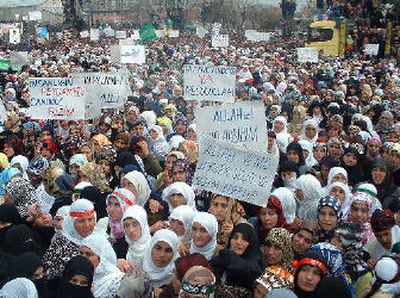

TEHRAN, Iran – The Iranian government on Sunday rejected an accusation by Secretary of State Condoleezza Rice that it has fanned violent protests over caricatures of Islam’s Prophet Muhammad and demanded an apology, saying that could reduce growing tension.
Rice, meanwhile, said Iran and Syria should be urging their citizens to remain calm – not encouraging violence like last week’s attacks on Western diplomatic missions in Tehran, Damascus and Beirut, Lebanon. Nearly a dozen people also were killed in protests in Afghanistan.
“If people continue to incite it, it could spin out of control,” she said Sunday on ABC’s “This Week” as furor mounted over the cartoons of Islam’s most revered figure that first appeared in a Danish newspaper four months ago.
The drawings – including one that depicts the prophet wearing a turban shaped like a bomb – have been reprinted in several publications in Europe, the United States and elsewhere in what publishers say is a show of solidarity for freedom of expression.
The images offended many Muslims as Islam widely holds that representations of the prophet are banned for fear they could lead to idolatry.
But some suggest the genuine anger displayed by crowds across the Muslim world has been exploited or intensified by some Muslim countries in the region to settle scores with Western powers.
Rice said Wednesday that “Iran and Syria have gone out of their way to inflame sentiments and to use this to their own purposes. And the world ought to call them on it.”
Iranian Foreign Ministry spokesman Hamid Reza Asefi said an apology from Rice and Denmark could help.
“What happened was a natural reaction,” Asefi said, adding that “an apology could alleviate the tension.”
He spoke as one of Iran’s largest newspapers opened a contest today seeking caricatures of the Holocaust. Hamshahri newspaper said it wanted to test whether the West extends its principle of freedom of expression to the Nazi genocide as it did to the cartoons of Islam’s prophet.
When asked by ABC to give evidence that Iran and Syria had incited the demonstrations, Rice pointed to the fact that little happens in the two countries without government permission.
“I can say that the Syrians tightly control their society and the Iranians even more tightly. It is well known that Iran and Syria bring protesters into the streets when they wish, to make a point,” she said.
Protests continued Sunday. Ultra-nationalist Turks, chanting “vengeance,” pelted the French consulate in Istanbul with eggs as about 2,500 pro-Islamic demonstrators shouted “Down with America, Israel and Denmark.” At least 30,000 protesters denounced publication of the drawings in a peaceful rally in southeast Turkey.
Graffiti insulting the Prophet Muhammad – including slogans equating him with a pig, an animal Muslims regard as unclean – also were found scrawled on a West Bank mosque.
Israeli soldiers erased the slogans, but they still touched off a protest in which three Palestinians were shot by Israeli soldiers. An Israeli woman also was slightly injured by stones thrown at her car.
The Iranian foreign minister told reporters Sunday that Denmark could have resolved the problem by apologizing immediately for the caricatures. He also repeated claims by Iran’s hard-line President Mahmoud Ahmadinejad that the drawings were part of an Israeli conspiracy.
Danish Prime Minister Anders Fogh Rasmussen reiterated Sunday that he cannot apologize for the actions of a free press.
He also said he agreed with Rice.
“It’s obvious to me that certain countries take advantage of this situation to distract attention from their own problems with the international community, including Syria and Iran,” he said on CNN’s “Late Edition.”