
Military-style alternative

They’re called cadets. They wear uniforms, live in barracks, walk in formation and adhere to rigorous military-style discipline, but they’re not soldiers. They’re students.
If the state Legislature approves Gov. Chris Gregoire’s proposed supplemental budget, 150 high school dropouts will be marching to a new tune at the Washington Youth Academy at Geiger Field.
The Washington Youth Academy won’t be a military academy, but a highly regimented, fully accredited alternative high school, with academically credentialed staff, run by the Washington Military Department.
The goal of the program is to give troubled teens a chance to improve their education, life skills and employment potential. There is no tuition cost; the program is financed with 40 percent state money and 60 percent federal money.
Retired Col. Curt Pintler is the state’s Youth Challenge Program manager. Pintler met with Cheney School District Superintendent Mike Dunn and his staff on Jan. 30 to discuss the school district’s role in the academy.
“We drove out to Geiger Field and looked at the site, and Mike and his staff were excited about the opportunity. We had real positive feedback from them,” Pintler said.
“Any time we get something from Western Washington for Eastern Washington, that’s a good thing,” Dunn said. The academy would be the only one of its kind in the state.
On Tuesday, Pintler, Maj. Gen. Tim Lowenberg and representatives from the governor’s office and the Cheney School District flew to Bend, Ore., to observe the Oregon Youth Challenge’s academy and to learn more about the school district-military department relationship and how it works.
Pintler said the state Military Department would contract with seven staff members from the Cheney School District – a principal and six teachers. These state-certified teachers will provide academic instruction in math, science, social science and computer science.
The military staff will provide training, discipline and supervision of the student population.
The Geiger Field location is the only site being considered.
“We went through an extensive facility search of military installations across the state, and we worked with (the Department of Social and Health Services) for possible state facilities. In the end, the Geiger Field facility was determined to be the best option, the most suitable,” said Pintler.
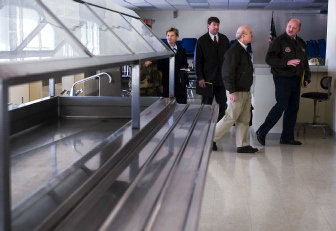
The academy would be on the state-owned Air National Guard base facility at Geiger Field, which is on the other side from the Spokane International Airport passenger terminal.
“We’re going to do a construction project for a new dormitory and we’re going to rehabilitate some existing vacant buildings. The Army Guard soldiers will be going to the new readiness center in the Valley near (Spokane) Community College,” said Pintler.
If approved, Washington will become the 26th state to offer the National Guard Youth Challenge Program to at-risk teens.
Financing for the academy would include $690,000 of the state’s general fund money as well as $3 million in capital funds and $1.3 million in federal money.
The program is for 16- to 18-year-olds who have dropped out or been kicked out of high school. They would attend a 22-week residential session, followed by a 12-month mentoring period.
The target date for opening the academy is July 2007. Classes for 150 students would be offered twice a year beginning in January and July.
Applicants must be legal residents of Washington state, and must volunteer for the program. There can be no pending legal action against them. They can’t be convicted of a felony, can’t be on probation for other misdemeanor offenses, must be free of drugs and physically and mentally able to complete the program. Typically 10 to 20 percent of students will drop out during the first two weeks of the program.
Nationally, 96 percent of those who complete the program obtain employment, continue their education or join the military, although there is no requirement for any military service.
Pintler said the mentoring aspect of the program is extremely important. After completing the program, students are paired with a mentor for a year.
“It’s this continued involvement of a positive adult role model that tends to cement the lessons learned and to continue on the positive track that they’ve established,” said Pintler.