
Fire levy

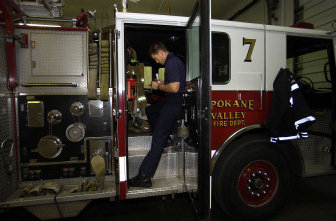
The bottom line: It would cost more per year for basic cable television than to approve the upcoming special levy for the Spokane Valley Fire Department.
While approval of the tax won’t provide daily entertainment, a “No” vote would significantly impact Valley fire’s ability to serve its customers.
Ballots will be mailed to Valley area residents next week. Voters are being asked to approve a tax levy that would raise $37.7 million over three years for the department.
The money would help to maintain current fire services, hire additional personnel, purchase new trucks and improve response times.
Special levies make up about 60 percent of the department’s total budget.
The current special levy, which makes up a third of what people pay now in taxes for fire services expires at the end of 2006.
“If people were to vote ‘No,’ the result would be losing half the fire department’s services,” said Larry Rider, an assistant fire chief for Spokane Valley Fire Department. “And that’s because special levies are the way our department has been funded since its creation (in 1940).”
The new levy would cost the owner of a $100,000 home, $170, or $1.70 per $1,000 assessed value for the first year. The current rate special levy is $1.57 per $1,000 assessed value of a home. The tax would be an additional $6 during the second year and the third year would be $13 more than the first.
This money would be coupled with the base tax for fire services.
For a basic cable television package at the current rate, it would cost about $216 per year.
The ballot, which is vote-by-mail only, is due by March 14.
“We do a really good job with the revenues that people have given us for fire services,” Rider said. “We are fortunate that we are able to put the decision to fund us in the hands of the voters every three years.”
The department serves about 125,000 residents in the Valley, which includes most of Spokane Valley, Millwood, Liberty Lake, Otis Orchards, Greenacres, Trentwood and surrounding areas of the county.
“The levy is needed because we’ve continued to see increased calls for service,” said David Lobdell, an assistant fire chief. “Between 2002 and 2005, we saw an increase of about 18 percent for calls for service. In 2005 alone, our call volume went up nearly 7.5 percent.”
The department has seen a 31 percent boost in fire calls and 11 percent increase in medical calls.
“What we are trying to do is be proactive and not backslide,” Lobdell said. “As the demand goes up and the traffic and congestion along with it, if we don’t prepare it will become increasingly difficult for the fire department to respond.”
The department’s response times are an average of just over 4 minutes. The goal is 4 minutes, officials said. “Every second counts.”
If the levy is approved, nine additional firefighters would be hired to staff the busiest stations, which are at Evergreen and 12th Avenue, University and Sprague Avenue, and the station on Sprague near the Interstate 90 underpass.
Currently it takes two trucks responding from different locations to have the necessary personnel on the scene of a call.
“On a typical truck there’s an officer, a driver and firefighter,” Lobdell explained.
Adding fire personnel to the busiest stations would assure that a paramedic also went on each truck.
“We have a goal of having an emergency medical technician (which can provide basic life support) on the scene within four minutes and a paramedic (which can provide advanced life support) on a scene within eight minutes,” Lobdell said. “By increasing the number of stations that have firefighter/paramedics, we have a better chance of meeting or exceeding that goal.”
In addition to personnel, the tax money would be used to lease or purchase six new trucks, maintain the current fire vehicles, replace staff vehicles, buy new protective clothing for firefighters and upgrade firefighters’ self-contained breathing apparatus to meet federal standards.
“It’s about service to the citizen,” Rider said.
“In our interactions with different groups we say: We’re here to serve you. What do you need from us?” said Mike Thompson, the department’s chief. “And that is a little different than what you typically see from government agencies.”
“Our department is more customer-service oriented than many government agencies,” Rider said. “We don’t get so disconnected with the taxpayers, because they have a hand in our revenue stream. They can say yes or no to our levy.”