
Hope fades at buried village
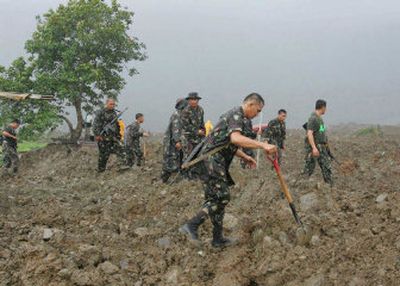
GUINSAUGON, Philippines – The soldiers shouted and pounded stones on boulders, hoping that anyone still alive in the mud-covered elementary school would hear and signal back.
But on a day filled with disappointment, misery and constant danger, their efforts were met with silence.
About 250 children and teachers had been in the school Friday when a landslide engulfed it and the rest of the farming village of Guinsaugon, about 400 miles southeast of the capital, Manila. Unconfirmed reports suggested that some survived in the school and had sent cell phone text messages to relatives.
Teams were also digging today around the site of the village hall, where about 300 people had been attending a women’s conference.
As the hours passed with no sign of life, though, hopes faded. The provincial governor admitted Saturday it would be a miracle if survivors were found anywhere where this village once stood.
Rescue workers were warned to tread carefully on the bog-like earth that could open up at any time to claim new victims. Fearing more landslides, 11 villages were evacuated.
The landslide, which followed two weeks of heavy rains, was believed to have killed nearly every man, woman and child in the village, which was covered with mud up to 30 feet deep.
The situation was so delicate that a no-fly zone was established over the area out of concern that blasts of air from the helicopters’ rotors could send the mud oozing again.
Medical supplies and excavation equipment were reaching the area on Leyte island, and U.S. military ships were expected today with 1,000 Marines. But with no survivors found since Friday, it appeared the operation would be recovery instead of relief.
Only 57 people were plucked from the mud Friday from the village’s population of 1,857. At least 58 bodies were recovered, including two today.
Officials had suspended the search after dark Saturday, with the footing too dangerous and no floodlights available to illuminate the 100-acre mud field, which was surrounded by a shallow stream.
President Gloria Macapagal Arroyo mentioned reports about cell phone messages sent by survivors in the swamped school during a televised staff meeting on the disaster. The reports gave impetus to the military to dispatch 60 soldiers to the area.
But as day turned to night, no signs of life were found, and officials admitted that they had been unable to confirm the existence of any genuine text messages from survivors.
Still, provincial Gov. Rosette Lerias said she was hoping for “a miracle.” “I would like to believe it’s true,” she said. “I am giving it the benefit of the doubt, and that is why we are concentrating on the school building.”
Not much else was left to concentrate on.”It’s hard to find the houses now,” said Eunerio Bagaipo, a 42-year-old farmer who lost two brothers, almost 20 nieces and nephews and a number of in-laws. “There is nothing now, just earth and mud.”