
Amid new growth, some prefer stubble
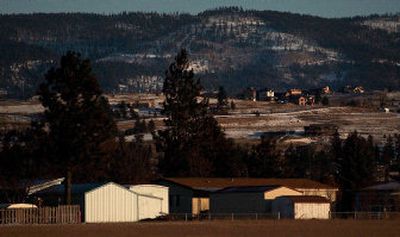
Mission Avenue, where it runs by Shirley Welch’s manufactured home, isn’t much to look at. Crab grass chews at its shoulders; potholes are wearing through its midsection. Its asphalt surface is cracked like desert mud.
It’s exactly the kind of road one would expect to take to “no man’s land,” which is how Welch and others refer to the region surrounding the road. They live beneath crackling 240-kilowatt power lines and endure the incessant whistle of radial tires on Interstate 90. Theirs is a sliver of county property sandwiched between two cities. To the north and east, hay stubble pokes through topsoil that is more rock than loam.
But recently there’s been a suburban desert bloom in no man’s land. Shiny new houses are cropping up like wildflowers to the northwest, and in the distant south, million-dollar homes are taking room on the barren slopes of Holiday Hills.
No man’s land is becoming someone’s land. Halting the transformation has been like stopping the wind.
“We moved out here because of the acres of alfalfa fields and the sprinklers going all the time,” said Welch, who lives with her 92-year-old mother. “It was really nice, but five years later came River Walk (a 500-home development to the northwest) and River Crossing (another 500 homes). Now there’s going to be 2,000 more homes going further east and a grade school at the corner of Mission and Holl.”
Neighbors in these parts expect that, despite objections from some, two weeks from today their underpopulated corner of the world will be annexed into Liberty Lake, a town of 5,000 people and three golf courses looking to double in size. In addition to the 2,000 homes, trails, a community fruit orchard and park are in the works, as well as a school and maybe even a downtown. Neighbors know this because they have been to all the annexation meetings and seen the PowerPoint about what’s in store for no man’s land. Centennial Properties, the company that owns the alfalfa fields surrounding Welch’s property, is looking to develop and is collaborating with Liberty Lake on annexation. The company is a subsidiary of Cowles Co., which also owns The Spokesman-Review.
Neighbors know that mobile homes are not illustrated among the trappings for this city of tomorrow. There are no mobile home parks in Liberty Lake, at least not now.
“They won’t move,” said Lorna McBride, one of the residents in no man’s land. “Most of them are older. The younger couples are in their 50s. Most of them own their land.”
McBride and her husband, John Jr., bought property 15 years ago in Greenacres Estates, which they’ve rented out ever since. Their last tenant didn’t move. He died.
John McBride Jr. was a key opponent to Liberty Lake’s annexation. He launched a petition opposing the move, spoke against it at all the hearings, and helped thwart a 2002 attempt by Liberty Lake to acquire the land by vote. The town needed a 60 percent majority to claim no man’s land. Voters, mostly from the mobile home neighborhoods, returned a no vote that was nearly the same margin. That election was just the second attempt to marry the 600 acres of no man’s land to Liberty Lake. Attempt No. 4 is under way now and making sound progress.
But the vote came in the beginning, when John McBride Jr. and others had the bottom of the hourglass all to themselves. New homes soon went up. New neighbors supporting annexation poured in like sand, and opinion had turned by the time annexation came up again. John McBride Jr. died last June, and all the neighbors of no man’s land are now older, more tired and more likely to give in.
“I like the name Liberty Lake a whole lot better than Spokane Valley,” said Pat Sale, referring to a brief attempt to acquire the land by the larger city to the west. Sale isn’t looking forward to the buzz of children that will come with a school and subdivisions filled with young homeowners. She looks out her window at the 240-kilowatt lines overhead and describes them as a buffer, a fence of sorts, because no one is building anything in an electrical field. Short of remaining a county island surrounded by an expanding city, the neighborhood’s best chance at peace could be the utility poles overhead.
On March 6, Welch will take the road from no man’s land east to Liberty Lake, where an evening announcement could make the annexation official. As she always does, she’ll soak in the silence of the vacant lots around here and keep a cautious eye peeled for deer.
Soon the road will be wider, edged by concrete and smooth as a kitchen floor, but homes will dot the landscape. Welch’s comfort in isolation will be gone.