
For more consumers, fluorescent’s a bright idea

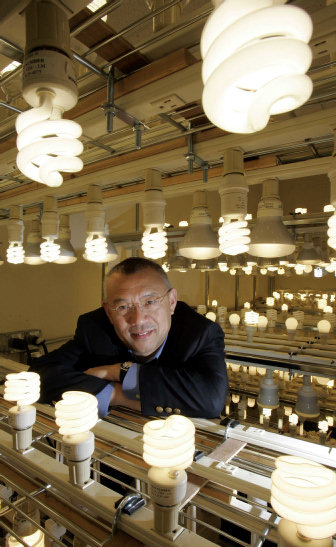
AURORA, Ohio – Julie Grassley wanted to do something for the environment and save money, so she replaced many of her Edison-inspired incandescent light bulbs with compact fluorescent lamps, which are enjoying robust growth in a high-cost energy era.
Grassley has heard all the gripes on fluorescent: slow to light up, not very bright and expensive. She doesn’t buy those arguments anymore.
“They are bright, and they come right on,” said Grassley, 37, of Stowe, Ohio. “Initially they are more expensive, but they last seven to 10 years longer.”
The lighting industry has created brighter, cheaper compact fluorescent lamps, or CFLs, that seem to be catching on among homeowners determined to trim high energy expenses. CFL use has climbed from 2.3 percent of the bulb market in 1999 to 5.6 percent this year.
The surge in demand has meant a boon for CFL makers, from lighting big wigs General Electric Co., Philips Lighting and Osram Sylvania to a smaller Ohio company, Technical Consumer Products Inc.
Though only a fraction of the size of its competitors, Technical Consumer Products, with 103 employees at its suburban Cleveland headquarters and 7,000 at its manufacturing location near Shanghai, China, has increased its sales more than fivefold since 2000 to $115 million last year and claims 40 percent of the CFL market, in large part from good shelf exposure at Home Depot.
Its president, Ellis Yan, has bet his career on educating Americans to use more CFLs. He think the share can grow to 10 percent or 12 percent in three to five years.
Yan said the biggest challenge in getting people to buy CFLs instead of regular bulbs is a century-old habit: People will buy an incandescent bulb without thinking.
“My competition is 6 feet underground – Thomas Edison,” Yan said.
Technical Consumer Products, whose CFLs are sold under the Commercial Electric and DuraBright labels, repeatedly emphasize savings on its packages: “This package saves you $118 in energy cost per bulb,” “Lasts 7 years guaranteed,” and “Lasts 8 times longer than standard bulbs.”
CFL prices have dipped from $10 or $15 to the $5 range, even less in bulk, but that’s still more than an incandescent bulb that can be had for 25 cents.
Lighting accounts for nearly 20 percent of electricity costs, with the average home having more than 30 light fixtures.