
Missile squadron closes
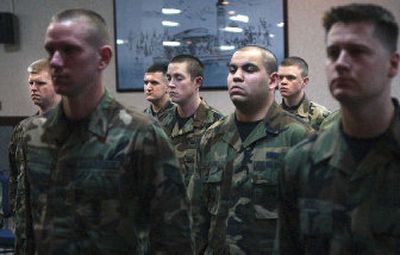
Fairchild Air Force Base’s bomber era came to an end Wednesday.
Though the base shifted the bulk of its mission to air refueling at the end of the Cold War, one squadron was left to maintain and store cruise missiles for B-52 bombers.
But the 2nd Support Squadron’s flag was rolled up and covered Wednesday, when it was deactivated in a subdued ceremony. Its work has been consolidated at Barksdale Air Force Base in Louisiana, home to the 2nd Bomb Wing it supported.
Just three years ago, more than 100 2nd Support Squadron airmen were busy at Fairchild loading missile “packages” onto B-52s bound for Iraq.
“You can guarantee that the 2nd Support Squadron was not a silent partner in the war on terror. They let their voices be heard loud and clear,” said Col. Bret T. Klassen, commander of the 2nd Maintenance Group, which provides logistical support to the 2nd Bomb Wing.
“Most of the air-launched cruise missiles fired during the shock-and-awe campaign in Iraq came out of Fairchild,” Klassen added.
Since the 1940s, Fairchild has been part of the Air Force’s bomber mission, housing B-29s, B-36s and finally B-52s until the last left in 1994 when Fairchild became an all-tanker base.
But the B-52s still had a reason to return – to pick up missiles.
The 2nd Support Squadron was formed in 1994 to store and maintain those missiles.
Twenty personnel will be moved to Fairchild’s 92nd Maintenance Squadron, storing and maintaining conventional munitions.
“It’s kind of tough to close down a unit,” said Klassen.
Now the cavernous igloos and superstructures that once held 50-foot cruise missiles stand empty.
The last of Fairchild’s missiles were quietly shipped out last summer, and now the few 2nd Support Squadron airmen who remain are closing down operations at Fairchild. They’ll be done by June 30.
Officials won’t say how many missiles Fairchild stored at its peak, but each of the superstructures could hold as many as six “packages” carrying six or eight missiles apiece, said Master Sgt. William Kowalski.
Looking inside the empty concrete buildings, it’s difficult to picture them filled with missiles, but evidence of their presence remains. Doors nearly a foot thick open to reveal copper cables and bars along the walls where they once served to ground the weapons. Noise- and motion-detecting alarms hang from the ceiling. And painted signs on the walls indicate the maximum explosive weight of weaponry allowed in each building.
In the case of superstructure 1489, that was about 15,000 pounds.
At one time, the base stored nuclear missiles, but those have been gone for 10 years, said Kowalski.
Though Fairchild’s bomber link will be severed with the 2nd Support Squadron’s deactivation, Spokane residents may still occasionally see B-52s in the skies above Fairchild, said Klassen.
It’s still considered an alternative base for B-52s in the Pacific region in times of bad weather or other emergencies. “The B-52 is not done at Fairchild,” he said.