
Historic South Hill garden hits pay dirt with $1 million
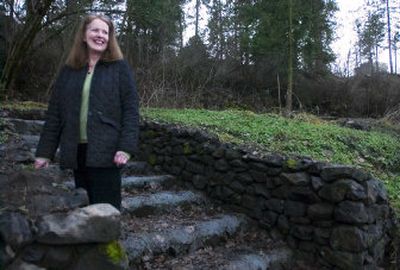
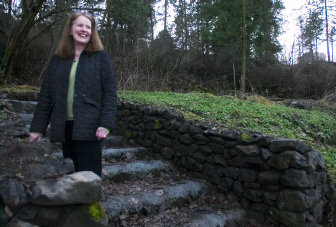
An anonymous donor has offered the city of Spokane more than $1 million to complete a historic renovation of the Moore-Turner Heritage Garden on the lower South Hill, officials said on Wednesday.
The city-owned garden of nearly three acres was once the playground of U.S. Sen. George Turner and his wife, Bertha. In 1903, the Turners hosted touring President Theodore Roosevelt. Their garden was the frequent setting for exclusive social occasions.
By the mid-1990s, the backyard landscape had virtually been lost beneath a tangle of forest overgrowth but was rediscovered during cleanup of tree damage from an ice storm in 1996.
For the past eight years, city staffers, preservationists and volunteers have sought to bring back the elaborate ruins, including outbuildings, ponds, arbors, planters, rock walls, pathways and staircases, not to mention its surviving trees and plants.
The gift announced by the city on Wednesday is expected to pay for a section-by-section restoration of the garden. The donor has also agreed to finance an endowment for ongoing maintenance of the garden. The plan calls for hiring a city parks gardener to oversee the work once renovation is finished in late summer 2007.
Already included on historic registers, the garden is an unusual park feature that promises to offer new insight into turn-of-the-century landscape and leisure pursuits.
“I think it will be a (tourist) destination,” said Lynn Mandyke, project manager for the restoration and director of Corbin Art Center near Seventh Avenue and Stevens Street.
The art center and heritage garden sit on the city’s 10-acre Pioneer Park, originally developed with homes for early residents.
“It will add even greater diversity to our parks system,” Mandyke said.
Mayor Dennis Hession, sworn in on Tuesday, said the large donation gives the city an unusual chance to complete a large project through a single funding source. The garden, Hession said, “will become one of the significant assets” in the city park system.
Parks Director Mike Stone said the heritage garden will complement the city’s other historic garden features, including those at Manito Park. “It will be a whole other type of experience,” Stone said.
Until now, the project has been financed through a series of grants from public agencies and foundations as well as private donations, but funding has been far short of the money needed for restoration and ongoing maintenance.
Stone said he sought a maintenance fund in the donation because of ongoing budget problems at City Hall.
Momentum for renovation dates to 1998 when historic photographs, scrapbooks and documents were retrieved from archives at Washington State University, where they had been kept under a donation from Mrs. Turner.
In 2000, the Moore-Turner Heritage Garden was placed on the Spokane Register of Historic Places as the city’s first cultural landscape. It is also on the Washington Heritage Register and is located in the Marycliff National Historic District.
The garden has been recognized by the Garden Conservancy in Cold Spring, N.Y., for its significance and has been visited by experts from the National Park Service. In 2004, the garden underwent a cultural landscape assessment, which forms the basis for the planned renovation work.
Mandyke said that only those features that can be documented from photographs and other historic records will be restored.
Construction of the garden dates to an 1889 Kirtland Cutter-designed mansion, which was built for F. Rockwood Moore, a founder of Washington Water Power Co., now known as Avista Corp. Moore initiated garden construction but died in 1895.
The garden is a mix of Victorian and Arts and Crafts styles and was expanded over a period of years by the Turners, who moved into the home in 1896. The mansion was torn down in 1940. City parks acquired the property in 1945.
Turner, who preferred to be called Judge Turner from his days on the court bench, served a single term in the U.S. Senate beginning in 1897 as a member of a political coalition called the Fusion Party. He also accepted an appointment by Roosevelt to the Alaska Boundary Tribunal in 1903.
Mandyke said the project will be divided into individual construction contracts for various elements in the garden. Previous grants paid for restoration of a major staircase and uncovering of rock ruins that provide the framework for the interior garden. Temporary fencing was erected around some of the most sensitive historic features to protect against vandalism.
Probably the most dramatic element is a 70-foot-long concrete basin that was reportedly stocked with trout for the amusement of Judge Turner and his guests. The pond and its adjoining arbor, which were shown in numerous historic photos, are included in plans for restoration.
A replica of the former mansion’s porte-cochere will serve as an entryway and provide historic context for what was once a residential garden.
Contractors will have to show experience in working on historic projects to qualify for bidding on the work, Mandyke said. “This is a sensitive site so it has to be treated as so,” she said.