
Rings all that remain of coastal batteries
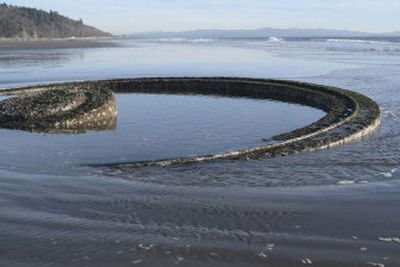
NORTH COVE, Wash. – The concentric concrete and iron circles hanging out of a huge dune near Washaway Beach look like something an alien might have left behind, like a set of crop circles cast in stone and then buried in the sand.
About 50 yards to the south, an identical set of concentric stone and metal circles is level with the sand and only visible when the tide is out.
The rings aren’t extraterrestrial in origin; they’re the last remnants of a military installation that once guarded the mouth of Willapa Harbor against foreign intruders. Known as “Panama mounts,” because they were first used in fortifications around the Panama Canal, the concrete emplacements are designed to hold the gun carriages of World War I surplus 155 mm “GPF” cannons, giant French-designed weapons capable of hurling a 96-pound shell 10 miles.
“During the First World War, Willapa Bay was defended with a temporary battery of 6-inch guns, emplaced near the old (Cape Shoalwater) lighthouse,” said Greg Hagge, museum specialist and artifact manager at the Fort Lewis Military Museum. “During World War II, a battery of 155 mm field guns were installed on Panama mounts, widely used by the Coast Artillery. These consisted of a permanent concrete ring and pedestal. The field gun could be mounted on the pedestal and have a 360-degree traverse, as well as a steady firing platform.”
The ring around the pedestal allowed the guns to retain their field trailer mounts. Instead of removing them, the trailing “legs” used to brace the weapon in the field would be locked into huge gear teeth on the concrete ring, and to turn the gun a crew of men with crowbars would “walk” each leg around, one tooth at a time.
The initials “GPF” stand for Grande Puissance Filloux, in honor of the gun’s designer, Lt. Col. de artillerie L.J.F. Filloux of the French Army (“Grande Puissance” literally translates as “Large Powerful”). The guns were produced in large numbers by the French during World War I, and the design was built under license in the United States between the wars.
Weapons similar to those at the North Cove site were also emplaced at Grayland State Park (now Twin Harbors State Park) during World War II, as well as in Westport and at Markham near the Ocean Spray plant.
The original 6-inch naval guns were moved from North Cove to Fort Worden, near Port Townsend, in 1936, according to Hagge.
Besides being a museum specialist for the Army, Hagge is also a member of the Coastal Defense Studies Group, an organization of history buffs that studies coastal fortifications and artillery.
“These were 6-inch Model 1900 guns from Battery Freeman, at Fort Stevens, Ore. They were later moved in 1936 to Fort Worden,” Hagge said, after looking at photos of some of the big guns at North Cove. “They were displaced by the same storm that destroyed the village of North Cove. The World War II guns, Model 1918 GPF, 155 mm field guns were mounted on the Panama mount that is washing out now. I haven’t seen photos or site drawings for the World War II sites in use. There are many photos of this type from other places.”
Since the first coastal defense fortifications were built on Cape Shoalwater during World War I, erosion has moved the coastline nearly two miles to the east. The lighthouse had to be abandoned in 1940, nearby state Route 105 has been relocated, and dozens of homes and some businesses have been destroyed.
The Panama mounts, last remnants of what was once America’s first line of defense, will soon disappear as well, Hagge said after visiting the site recently.
“The concrete ring of the No. 1 gun position is exposed over the edge,” the museum specialist said. “The gun pintle center is right at the edge. This will slide over very soon. The No. 2 gun position is another 50 yards south and out to sea about as much. It may be exposed at low tide but is likely flush with the surface of the sand. The tide was in so we did not see that one this time.”
Pacific County Museum director Bruce Weilepp says the guns’ installation was a serious challenge for the Army.
“They couldn’t get them in by rail,” Weilepp said. “So they brought a barge in as close as they could and then hauled them with trucks and teams of horses the rest of the way.”
Weilepp and Hagge are both interested in any surviving photographs or artifacts of the Army installations that once guarded the entrances to the Twin Harbors.
“Not much in the way of photos has surfaced,” Hagge said. “If you have access to photos of these or other WWII guns or buildings, I’d like to see them.”