
A healing touch from a furry friend
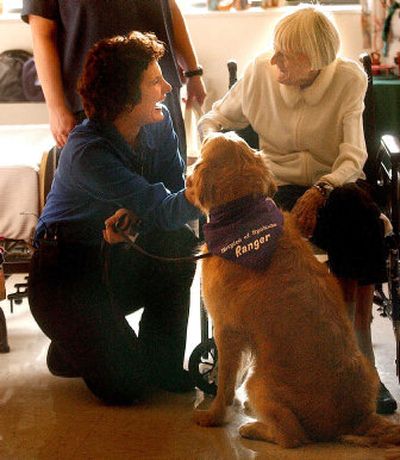
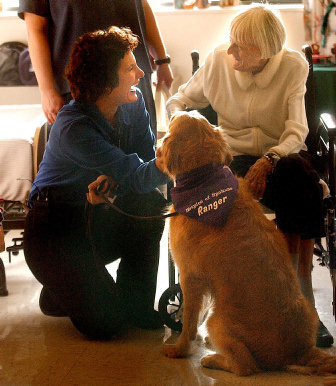
OK, Ranger’s paws might not be the best for surgery. But this doctor doggy delivers exactly the right prescription: smiles.
Ranger, who will turn 3 in February, has spent much of his golden retriever life bringing cheer to patients around Spokane. He is one of nine dogs of various breeds who work under the Hospice of Spokane’s “Paws for Comfort” Pet Therapy Program.
Ranger visited 88-year-old Dorothy Fredericks on Wednesday, sort of a ritual between the two for some time now.
“Isn’t he beautiful,” Fredericks repeated as she petted Ranger’s gleaming golden coat. Sitting in her wheelchair, the thin-framed Fredericks smiled at her visitor. “He’s so great, aren’t you Ranger?”
While animals have been used in visits to hospital and nursing home patients for years, the Spokane program is the first in-home animal-assisted therapy program in the United States, according to Hospice. Paws for Comfort is designed to introduce pets into the lives of the terminally ill patients under Hospice care. The animals also visit Hospice patients in medical facilities.
Trina Poppens, who has worked as a Hospice of Spokane social worker for 13 years, started the program with the help of Hospice volunteer Greg Renner in 2003.
“I wanted to offer people a chance to reconnect with a pet,” Poppens said.
Often, she said, people who are ill enough to become Hospice patients lose the ability to take care of their pets, many of whom might be their only companion.
“People who are dying or in nursing homes are very isolated from the world out there,” Poppens said. “When you become ill, your world shrinks, too.”
The program allows people to reminisce about their pets, helps reduce stress and anxiety, encourages people to open up to those around them and much more, she said.
Curtis Springer was 15 when he became the first Hospice of Spokane patient to become part of the animal-assisted therapy program.
Tumors were attacking his body, Poppens said, and his doctor wrote him a prescription for a dog to help him cope with the situation. But the workload of caring for the animal would have been too much for the boy, so Hospice volunteers and their pets filled the void.
Curtis was able to go to the park with Dagwood, a golden retriever, to play ball and have a picnic with Hospice volunteers and, Poppens said, “he had kind of a normal outing that most people take for granted.”
Curtis lived for two years after pet therapy, and he spent time with seven different dogs. In August 2005, the tumors took over and Curtis died, but he helped begin something great, Poppens said.
Animal-assisted therapy has helped immensely in her social work, Poppens said, helping to open up many people who have trouble speaking with her. She gives the example of the siblings of a dying infant whom she could not get to speak about what was happening or how they were feeling. Then she brought a dog into the mix.
“And they dressed him up … put bows in his hair, and they laughed and began to talk,” she said.
Remy the Doberman helped a woman in her 90s who was hurt and angry about being abandoned by her daughter.
“But when she saw Remy she just lit up,” Poppens said.
Ellen Higgins, Remy’s owner, said that some people don’t expect the 9-year-old Doberman pinscher to be friendly, and some are picky about the types of dogs they want visiting them – and it’s typically not a Doberman, a breed sometimes used as guard dogs. But then he enters the room, and their attitude changes, she said.
“He just kind of worms his way into their affections,” Higgins said.
And so he did with the abandoned woman, who decided that nothing would do but to sit on the floor with Remy and have him lie in her lap. Visits continued until her son took her to Yakima, where she died soon after.
Other volunteers have seen similar results.
Karen Hathaway, an evaluator who examines dogs before they are certified to begin the therapy work, also takes her three collies to patients.
She took one collie to visit a man who had a stroke and was completely paralyzed. Volunteers and others in the room began to cry when the man, for the first time since being hospitalized, moved his thumb to pet the animal that lay on the bed with him.
One ill child who refused to believe a visiting collie was anything but a horse, wanted a ride. So Hathaway told the girl’s grandfather to hold her over the dog and they trotted around the hospital.
“Everybody has stories like that,” Hathaway said. “For just one second they’ve been able to focus on something that’s non-threatening. You might get nothing else but a smile, but that’s all you need.”
Debbie Wing, the only certified animal-assisted therapy instructor east of the Cascades in Washington, said dogs aren’t the only animals certified for visits.
Wing, a nurse at Eastern State Hospital in Medical Lake, said she might have the only therapy cat in Washington, and another volunteer has a miniature horse certified in Spokane County.
The animals provide more than just smiles. When Italian researchers placed canaries in rooms, elderly patients gained a more positive outlook on life. In Budapest, health and social skills improved significantly among schizophrenic patients visited by dogs.
The American Heart Association linked the lowering of blood pressure and other heart issues to the use of animal-assisted therapy.
But it doesn’t take a scientist to see that patients are smiling when animals enter the room. While there may be medical benefits to pet therapy, some people just enjoy the company.
Wednesday, as Ranger entered the room at the Royal Park Care Center with his handler, Suzie Michalek, Fredericks greeted him with a hello and they began their ritual – they sat and she talked, and he received her petting. Ranger even shook her hand.
“Sometimes he comes into bed and we talk,” Fredericks said, then smiled at the thought of her words. “The dog talks.”