
Dow passes 11,000 milestone
NEW YORK — What took it so long?
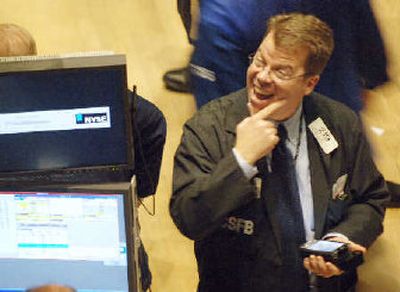
The Dow Jones industrial average closed above 11,000 Monday for the first time in more than four years — one indicator of Wall Street’s slow recovery from terror attacks, recession and corporate scandals.
The Dow, comprising 30 big-name large-cap stocks from Alcoa Inc. to Wal-Mart Stores Inc., had a sleepy 2005, losing 65.51 points, or 0.61 percent, for the year. Hitting 11,000 merely means the Dow is “catching up with the other averages,” said Alexander Paris, economist and market analyst for Chicago-based Barrington Research.
“It’s just a matter of the market evening itself out,” he said. “The Dow was the only average in 2005 that didn’t go up. The Dow has been below not only small-caps, but other large-caps.”
In the first five trading days of the year, the Dow rose 2.75 percent, trailing the Standard & Poor’s 500 index, which is up 3.35 percent and the Nasdaq composite index, which is up 5.14 percent.
When the Dow last closed above 11,000 in June 2001, the Internet and telecom bubbles were in mid-burst. Business reporters wrote about “the new economy” and “the old economy” without irony. Google Inc. was privately held and gold was trading at $280 an ounce, near 20-year lows.
Now the Internet and telecom bubbles are dim memories, no distinction is made between “new” and “old” economies, Google Inc. closed Monday up $1.24 at $466.90 and gold is setting 25-year highs, hitting $549.10 Monday. And the Dow is still 711.08 points, or 6.07 percent off its bull market peak of 11,722.98, reached on Jan. 14, 2000.
The other thing that’s changed: Large-cap stocks as a group — and many of the specific names in the Dow 30 — have fallen out of favor. “Will large caps ever grow again?” asked a recent Merrill Lynch report.
“The big blue-chip stocks have been the laggards for about five years,” said Edward Yardeni, market analyst at money manager Oak Associates Ltd. “Many blue chips are viewed as mature companies that aren’t likely to show growth much exceeding GDP (Gross Domestic Product). Lots of names have managed to do that over the last five years, yet they haven’t been accorded much respect.”
That said, none of the indexes have regained their bubble heights. The S&P 500 is down 237.31, or 15.54 percent below its peak of 1,527.46 in March 2000. The Nasdaq is 2,729.93, or 54.07 percent, below its peak of 5,048.62, also of March 2000.
But the Dow, with only 30 stocks, only needs a couple losers to keep it down. And it has had more than a couple:
• Dow component General Motors Corp. has swooned over the past two years as its market share has fallen and concerns over its high salary, pension and health care costs have intensified. The stock was trading above $50 in January 2004. Monday, it rose $1.61 to $22.41.
Big pharma Dow components Merck & Co. and Pfizer Inc. have likewise seen their stocks sink.
Merck fell $12.07, or 27 percent, to $33 a share on Sept. 30, 2004, when it announced it was withdrawing its painkiller Vioxx. Lawsuits, declining sales and the resignation of its CEO followed. The stock has never recovered. It closed Monday up 54 cents to $33.66.
Pfizer investors have had less drama, but a fair share of agita, worrying about the company’s expiring patents, a lack of new drugs, falling Viagra sales and safety concerns about painkiller Celebrex. The stock was unchanged Monday at $24.85, down from its adjusted five-year high of $46.75.
Citigroup Inc., the world’s largest financial services company, has seen its reputation stained by regulatory problems; its private banking unit was kicked out of Japan in 2004. Citigroup’s price-to-earnings ratio is an anemic 11.04, compared to a price-to-earnings ratio of 13.91 for smaller competitor Merrill Lynch & Co. Citigroup fell 23 cents to $48.39 Monday, down from its adjusted five-year high of $53.53.
• Likewise, retailer Wal-Mart Stores Inc. has a price-to-earnings ratio of 17.82, which pales next to the 22.89 price-to-earnings ratio for smaller competitor Costco Wholesale Corp. Wal-Mart also faces an image problem brought on by a series of lawsuits and complaints about how it treats its workers. Most recently, a California jury fined it $172 million in December, saying the chain illegally denied employees lunch breaks.
The stock fell 17 cents to $45.71 Monday, down from an adjusted five-year high of $63.94.
Advancing issues topped decliners by about 11 to 5 on the New York Stock Exchange, where preliminary consolidated volume of 2.33 billion shares lagged the 2.48 billion shares that changed hands on Friday.
The Russell 2000 index of smaller companies advanced 6.85, or 0.98 percent, to 706.24.
Overseas, Britain’s FTSE 100 lost 0.01 percent, Germany’s DAX index rose 0.01 percent, and France’s CAC-40 was higher by 0.16 percent. Japan’s stock market was closed Monday for a national holiday.