
Kempthorne defends tax relief plan
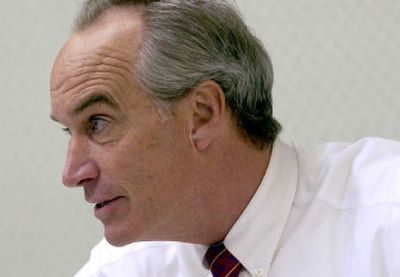
Gov. Dirk Kempthorne is adamant that it’s the job of local counties and cities – not the state – to fix the property tax dilemma that is pricing people out of their longtime homes.
While in Coeur d’Alene on Thursday, the governor made no apologies for making a property tax proposal this week that focuses only on giving relief to the state’s elderly, poor and disabled. He recommends expanding the “circuit breaker” exemption and setting up a deferral program for seniors.
He said perhaps it will force cities and counties, along with state legislators, to finally look at options other than having the state contribute more money to give residents tax relief. He questioned where that money would come from and rhetorically asked if lawmakers would choose to cut education spending or health care.
Kempthorne added that he was “amazed” that a dozen meetings held across the state this summer by an interim legislative tax committee didn’t produce more solutions. Instead, he said, the committee only focused on how the state can provide more money for property tax relief.
“There should have been a much more thorough discussion,” Kempthorne said in a meeting with The Spokesman-Review’s editorial board.
The message disturbs North Idaho legislators and local county officials.
Kootenai County Commission Chairman Gus Johnson, a Republican, said he was disappointed Kempthorne “turned a deaf ear” to the topic and put the responsibility on the counties and cities.
“If it’s a local problem, why didn’t the locals have workshops this summer?” he said. “Why did the Legislature have them? Everyone knows the Legislature can solve some of those problems.”
Johnson and many other elected officials expected Kempthorne to embrace the recommendations of the interim committee that included raising the homeowner’s property-tax exemption from $50,000 to $75,000 and to include land value.
He pointed out that the homeowner’s exemption is a state law, which means the Legislature needs to adjust it, not local governments. The exemption hasn’t been adjusted for inflation since it was enacted by initiative in 1982.
Legislative budget writers this week also quibbled that property tax levels for school maintenance and operations are set by the state, and the state controls many aspects of the system.
Kempthorne reiterated that the state is a partner in the property tax situation. He reminded people not to forget that the state gives $325 million a year to local governments to help fund services that would otherwise come from property taxes.
He said the cost of the current legislative property tax proposals equals about a 1 percent increase in sales tax, which also isn’t a popular idea with Idahoans.
While resort communities such as Coeur d’Alene and Sandpoint are struggling with property value increases of as much as 250 percent in one year, Kempthorne said other Idaho communities don’t have such growth. Their property values are actually going down. The governor said these counties have asked him not to “upset the cart” by restructuring the property tax structure just to benefit a few resort areas.
Yet Kempthorne said he was “sympathetic” to the struggles in North Idaho.
He said his proposal ensures that senior citizens on fixed incomes or people with disabilities won’t be priced out of their homes.
He proposes spending an additional $7.3 million to add about 10,000 elderly and low-income households to qualify for the $1,200 yearly tax break. He also wants to set up a tax deferral program for the elderly that would be an added safety net.
Johnson said not only are counties limited by the state in how they can generate additional revenue outside of property taxes but that the state hasn’t been willing to give them additional tools.
He points to repeated attempts to expand the local option sales tax so it can fund projects other than jails. But few expect that to become a high priority this session.
Kempthorne said that he was instead interested in championing other issues such as lowering the supermajority vote needed to pass school bonds. He wants to send a constitutional amendment to voters to reduce the supermajority to 60 percent from the current 66.6 percent.
He also wants to send every Idahoan a $50 check to offset high energy costs, at a total cost to the state of $63 million. That proposal is also getting a mixed reaction.