
Schools face ESL gap
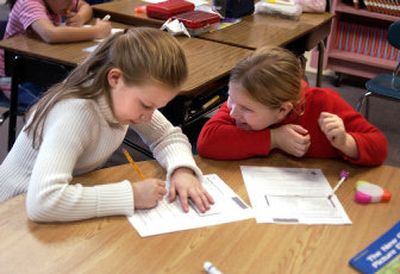
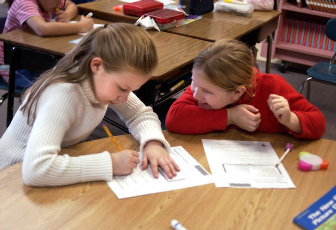
Nine-year-old Luba Motora doesn’t ask her parents for help with her homework.
“I just do it myself,” the Trentwood Elementary School student said.
It isn’t because her parents don’t want to help. It’s because the work is written in English and her family, immigrants from Ukraine, speak only Russian.
Teachers also have difficulty explaining to parents what is expected, because of language barriers.
“The biggest piece of anxiety for teachers is communicating and dealing with ESL (English as a second language) parents and students,” said Trentwood Principal Sigrid Brannan.
Under a new grant awarded to the East Valley District school, Brannan is hoping to bridge that communication gap.
It’s called the Partners grant, and the primary goal is to increase the reading ability of English language learners, and to improve communication between teachers and the families of language and cultural minorities.
“The question is how do we here at school involve the non-English-speaking parents,” Brannan said.
The grant is funded through Eastern Washington and Washington State universities by the Higher Education Coordinating Board.
“The focus is really on the university and the school district partnering up and looking at this together; and the university sharing what we know to help the teachers understand some of the disconnects,” said Gina Petrie, a professor of modern languages at EWU.
A group of seven teachers and staff members at Trentwood meet with Petrie about once a month to discuss challenges and come up with strategies to help widen the communication with non-English-speaking families. They also have access to a Web site, where they communicate with teachers from two additional schools involved in the project in Battle Ground, Wash., and the Okanogan School District.
“One of the things we’re doing is we’re looking at how that communication breaks down when parents speak a different first language and are coming from a different cultural background,” Petrie said. “What we know through research is that the communication is often not very successful.”
The population of students from Russia and Ukraine is one of the fastest-growing minorities in Valley schools.
About 10 percent of the students at Trentwood are Russian-speaking immigrants. Other English language learner populations at the school include Hmong and Spanish-speaking minorities.
The students have slowly moved from other nearby school districts into Spokane Valley, district officials said.
“Our ESL population is pretty transient; a lot of times once they get established they moved over to the Valley,” said Barney Brewton, an administrator with Post Falls Public Schools.
For the past several years, the majority of foreign students in Spokane Public Schools had been coming from Russia and Ukraine, but that influx has slowed considerably, said Dottie Weldon, the district’s special programs coordinator. Now they’re seeing many Russian families migrate both north to the Mead School District and east to Spokane Valley schools, Weldon said.
In the years of dealing with Russian students, Weldon and her staff have learned that many cultural norms from the Russian schools still linger.
“They didn’t have the kind of parent conference the way we have them in America,” Weldon said. “If they ever got called, it was for bad things.”
“Communication is very much a two-way street in American families. But for Russians the way you show trust and respect for the school is to never come,” added Trentwood’s Brannan. “We want to be able to honor their culture, and we want them to know we’re glad they are here.”
Motora’s teacher, Sandy Blair, has three Russian-speaking students in her third-grade class this year. She continually tries to think of ways to get parents into the classroom to volunteer. Usually, through a translator, the parents decline.
“To them, if they have to come here, it means they are poor parents, or the children are troublemakers,” Blair said. “It is just not proper to them.”
So the teacher has learned to continually be looking for ways to connect with the families. Before the holiday break, she had the girls’ mothers send desserts for a “Christmas around the World” celebration.
“It really made the girls feel special,” Blair said. “It takes a lot of physical and emotional energy to learn a new language and a new culture. I think we all take that for granted.”