
ION Red Line one smokin’ Saturn

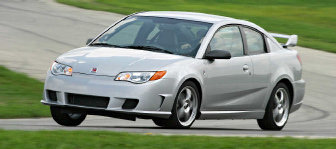
Saturn builds solid cars, sells them in a customer-friendly environment and services the heck out of them.
Saturn does not build exciting cars.
Amend that: Saturn didn’t build exciting cars.
Anxious to grab a chunk of the youthful tuner market, Saturn introduced two new performance models for the ‘04 model year. The up-level “Red Line” editions of the ION coupe and VUE SUV featured supercharged power plants, sport-tuned suspensions and a bagful of cosmetic upgrades.
We drove an ‘05 Saturn ION Red Line; ‘06 editions are essentially unchanged.
Based on the innovative ION “quad coupe,” the ION Red Line competes in the same tuner space as Dodge’s Neon SRT-4, the Civic Si, the late lamented Ford SVT Focus and Chevy’s Cobalt SS, itself a mechanical cousin to the Red Line.
The tuner category has been dominated by the Asians and was mythologized in the 2001 movie “The Fast and the Furious.” Unlike the over-the-top, owner-modified cars lionized by the film, though, the ION Red Line is a “factory tuner,” a car ready to romp right off the showroom floor.
No late nights on cold, concrete floors installing balky custom exhaust systems, no wrestling with ill-fitting aftermarket body add-ons and, perhaps most important, no warranty hassles.
You can tell an ION Red Line by its distinctive front fascia, body sill extensions and 17-inch low-profile tires, but the heart of the package is a beefed-up and de-stroked (from 2.2 liters) 2.0-liter Ecotec engine. Fitted with a Roots-type supercharger, Laminova air-to-water intercooler and high-flow air intake and exhaust systems, it pumps out 205 horsepower and 200 foot-pounds of torque at 4,400 rpm.
With its truncated stroke and reinforced crankshaft, connecting rods and pistons, the engine is potentially capable of greater rpm and more power. Cooling shouldn’t be a problem, as the Red Line gets an enlarged radiator core and bigger cooling fans.
General Motors prefers supercharging to turbocharger because it eliminates turbo-lag, delivering power more smoothly across a broader torque band. Indeed, we found power delivery via the electronically controlled throttle to be immediate.
A five-speed, short-throw Getrag gearbox ties the power plant to a pair of equal-length half shafts. The Getrag’s tall and evenly spaced gearing is intended to keep the engine in its sweet spot throughout the gears, but combined with the ION’s 2,950-pound curb weight, curtails quarter-speed times.
Still, 0-60 in 6.2 seconds isn’t half-bad for a car that shades a hair over the $21,000 mark.
A limited-slip differential, part of a $1,470 Competition Package that also includes boost gauge, ladder-style tach and projector-beam fog lamps, helps keeps the tires planted.
The half-shaft setup does an admirable job minimizing torque steer, a perennial bugaboo for front-drive hotrods. GM doesn’t say so, but it’s possible the ION borrows Saab’s anti-torque-steer geometry; the two are corporate cousins, after all, and some of the ION’s interior switchgear carries Saab parts numbers.
Saturn hangs the Red Line’s suspension components on GM’s European-designed Delta architecture. Shock and bushing settings are stiffer than stock and the anti-sway bars are beefier.
To increase the contact patch, performance-rated 45-series Continentals are mounted on 17-by-7-inch, six-spoke forged alloy wheels.
Brakes are similarly upsized, to 11.6 inches up front and 10.6 inches rear. Five-bolt wheel hubs and brake calipers and pads are oversized, as well, and in tests have shown themselves to be both powerful and fade-resistant. Red Line ride height is lowered 10mm from stock and on the skid-pad the Red Line pulls 0.85 lateral Gs.
GM’s electric power steering system has taken its share of knocks in a variety of applications, but for the ‘05 ION Red Line it has been recalibrated for quicker response and better on-center feel.
GM’s Performance Division designed the new front and rear fascias, which are highlighted by a deep air inlet up front and a cutout for the large chrome exhaust tip out back. Rocker moldings enhance the Red Line’s low-slung appearance and a deck lid spoiler is standard, with larger wings available. Other options include a mesh screen grille.
While dramatically improved over earlier models, in terms of fit and finish and feel of the switchgear, the interior still suffers from an overabundance of dark plastics.
The seats, authentic Recaros, need a hair more side-bolstering and adjustable lumbar. They are thinly padded and positioned lower than necessary. Their positioning brings down the center of gravity but reduces the chances of finding a comfortable driving position.
The leather-wrapped steering wheel is thicker and easier to grasp for ‘05. The pedals are nicely positioned for heel-and-toeing, but the dead pedal feels like nothing more than a lump of mushy carpeting.
Dual-stage front airbags are standard and curtain-style bags are optional. Side-impact bags are not available.
I continue to resist the trend toward center-mounted gauges, especially in a car that requires split-second timing for maximum performance. To compensate for the lack of an easy-to-see tach, Saturn mounted shift lights in the driver’s line of site – 4,400 rpm for peak torque, 5,600 rpm for peak horsepower.
Despite its skidpad numbers, the Red Line is sluggish in transition, due largely to its 103.4-inch wheelbase, which is long for the class, and it understeers substantially when cornering at speed.
I didn’t have a chance to put it through its paces, but those who have say the Red Line needs a touch of left-foot braking to keep the front tires loaded when cornering; otherwise, it pushes through the corners.
Saturn’s ION Red Line aims for a small and discerning market. Any headway it makes with young buyers will come at the expense of the Japanese – a prospect that means increased competition and better products from all corners. All indicators are Go for more fun ahead and that’s a positive trend for Saturn.