
Iran’s nuclear plans persist
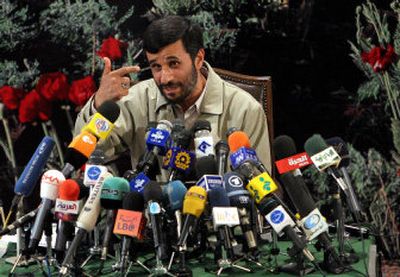
TEHRAN, Iran – Iranian President Mahmoud Ahmadinejad pushed back at President Bush and European leaders on Saturday, insisting Iran will press ahead with its nuclear program despite the threat of economic sanctions because “ultimately they need us more than we need them.”
At a news conference that lasted more than two hours, a confident Ahmadinejad posed a question to Western governments: “So why do you strike a mighty pose? I advise you to understand the Iranian nation and revolution in a better way. A time might come that you would become regretful, and then there would be no benefits in regretting.”
Ahmadinejad’s remarks, broadcast live on international news networks, brought to a confrontational close a week in which Tehran defied a U.N. watchdog agency by resuming nuclear research that had been suspended for 2 1/2 years after going forward almost two decades in secret. Iran’s removal of seals on nuclear equipment at its enrichment plant at Natanz and preparations to resume research brought a cascade of criticism, with Bush saying Friday that the prospect of an Iran armed with nuclear weapons was “a grave threat to the security of the world.”
Diplomats from the United States, Europe, Russia and China are scheduled to gather Monday in London to discuss shifting Iran’s file from the International Atomic Energy Agency to the U.N. Security Council, which could impose sanctions.
The defiant notes struck again and again by Ahmadinejad vividly described the chasm that separates Iran and the Western powers struggling to contain its nuclear ambitions.
Ahmadinejad called it “laughable” that his assertions that Israel be “wiped off the map” and his reference to the Holocaust as a “myth” may have seeded doubts about the peaceful nature of Iran’s nuclear program.
“We don’t need nuclear weapons,” Ahmadinejad said, noting that religious doctrine restrained Iran from unleashing its own stocks of chemical weapons when Iraq gassed Iranian troops during the 1980s. “Nuclear weapons are pursued by those who want to solve everything by bullying everyone.”
He challenged the United States to open its own nuclear facilities to U.N. inspection. Reversing a warning Western leaders leveled last week at Tehran, he advised Washington and Europe “not to isolate yourself anymore in the family of nations.”
“They confront us and deal with us in a very harsh and illegal language, but ultimately they need us more than we need them,” Ahmadinejad said.
“They’re telling us you should build confidence, trust. Let me tell you, for two and a half years that point was made. Now I tell you, it is high time for the E.U. countries to provide some trust for us.
“We have to understand they do not want the Iranian nation to have technological programs.”
The argument goes to the heart of Iran’s rationale for pursuing a nuclear program despite its vast petroleum reserves. Leaders of the theocratic government, which regards itself as the leader of the Islamic world, say they are defying the relatively recent colonial past and hearkening back to the era when Muslims pioneered discoveries in medicine and math.