
Chile elects first female president
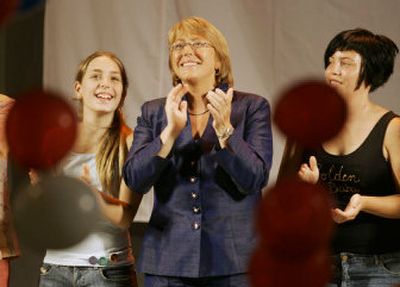
SANTIAGO, Chile – A socialist doctor and former political prisoner was elected Sunday as the country’s first female president, defeating a conservative multimillionaire opponent in a race that reflected Latin America’s increasingly leftward tilt.
The victory of Michelle Bachelet – a political prisoner during the dictatorship of Gen. Augusto Pinochet and defense minister in the current administration – extends the rule of the market-friendly, center-left coalition that has governed since the end of Pinochet’s 1973-90 rule.
“Who would have said, 10, 15 years ago – that a woman would be elected president!” Bachelet told thousands of supporters.
The president-elect on Sunday also recalled her imprisonment and torture under Pinochet, saying that “violence entered my life and destroyed what I loved.”
With more than 97 percent of some 7.2 million votes counted, Bachelet had more than 53 percent of the vote to just over 46 percent for Sebastian Pinera, who congratulated his opponent on her victory but vowed “to continue to fight for our principles, which do not die today.”
Sunday’s runoff was necessary after a Dec. 11 election involving four candidates failed to produce a winner with a majority.
Her political success has baffled many Chileans who thought a left-leaning single mother jailed during Pinochet’s dictatorship stood little chance in this socially conservative country.
Current President Ricardo Lagos made her his health minister, then in 2002 named her defense minister. She won praise for helping heal divisions between civilians and military left over from the dictatorship.
Bachelet had expected resistance from Chile’s conservative military establishment when appointed defense minister. “I was a woman, separated, a socialist, an agnostic … all possible sins together,” said Bachelet, who nonetheless became a popular figure among the admirals and generals.
Bachelet will be only the third woman directly elected president of a Latin American country, following Violeta Chamorro, who governed Nicaragua from 1990 to 1997, and Mireya Moscoso, president of Panama from 1999 to 2004.
However, Bachelet, unlike those two women, did not follow a politically prominent husband into power.
The 54-year-old Bachelet made clear she intends to maintain the free-market policies that have turned Chile’s economy into one of the strongest in the region.
“We will continue to walk the same road,” she said.
Chile’s next president will be inaugurated on March 11, joining the ranks of Latin American leaders including leftists such as Venezuela’s Hugo Chavez and newly elected Evo Morales of Bolivia. Bachelet indicated she would work with all the region’s leaders. “We shouldn’t take Latin America back to the Cold War. Chavez, Morales, they are presidents elected by their peoples. Chile must have relationships with all of them.”