
Doc goes where the patients are

At 98, Clay Rook is old enough to remember when doctors made house calls – and when they needed a horse and buggy for the trip.
So when Dr. Stan Shapiro shows up with a small black medical bag and a gentle smile, the Mica Flats resident takes it in stride.
“I feel great,” he says, propped on pillows in his bedroom, a green plaid blanket draped over his legs. “I don’t know that I had anything wrong with me.”
But for Rook’s caregivers – his niece and nephew – few sights were more welcome last week than Shapiro’s white Dodge Ram truck.
“What a blessing to see him pull up in your driveway,” says John Rook, 69, who spent two months trying to find accessible medical care for his frail, possibly ill uncle. “I just can’t tell you how difficult it is to find a doctor who will come to your house.”
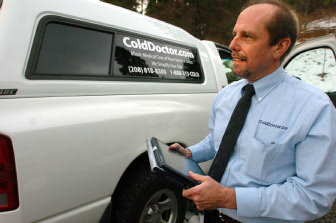
The white rig is Shapiro’s office on wheels, the self-contained center of ColdDoctor.com, a business that the former Kellogg internist and emergency room doctor says is a whole new way of practicing medicine.
Shapiro, 55, shucked his post in the Shoshone Medical Center ER last summer. After 14 years there and six years in private practice, he says he was tired of the long shifts and static scenery.
“It was 25 years since I slept every night of the week,” Shapiro says. “I thought, ‘How can I meet fun, interesting people, work days and not really work a lot?’ ”
The answer, it seems, is a medical practice that focuses on drive-up service for minor ailments. Instead of life-threatening injuries and illnesses, Shapiro now treats nothing more serious than sore throats, coughs, colds and earaches.
“It’s the things that aren’t going to kill you, but you don’t have three hours out of your day to deal with it,” Shapiro says.
The goal of the business, which began in October, is to provide convenient care for folks too busy or incapacitated to go to a doctor’s office, Shapiro says. He imagines his customers will be upper-middle-class professionals or retirees – people with incomes of $60,000 to $70,000 a year who don’t flinch at his flat fee of $119 or $149 per appointment, depending on the time of day.
Shapiro doesn’t accept or bill medical insurance, and he takes only cash or credit cards. He won’t treat children under age 5 – “Babies are at a higher risk for serious disease,” he says – and he won’t see anyone with potentially difficult problems.
“I don’t do belly pain; that usually needs an X-ray,” says Shapiro, who screens patients by phone before agreeing to see them.
That’s partly in deference to legal risk. Shapiro says he spent about $20,000 to start the business, including about $6,000 in medical malpractice insurance fees. But he also wanted to set limits on patients and conditions to maintain the professionalism of his practice.
“I have set standards of quality care for myself,” he says.
So far, only a few clients have hired the drive-by doctor. Even Shapiro admits that some people might be leery of a physician whose shingle consists of an Internet address and the painted sign on his truck.
Still, anyone who checks will learn that the doctor holds a current license with the Idaho state Board of Medicine and is a member of the Idaho Medical Association.
“He’s a real doctor,” says John Rook, who needed medical care after he moved his uncle to Idaho from an Arizona nursing home last fall.
For John Rook and his sister, Dot Rook, 65, the prospect of getting their uncle out of his in-home hospital bed, into a wheelchair, into a car and down to the doctor was exhausting to contemplate. When Clay Rook developed a cough, his nephew called every agency he could think of, trying to find a mobile doctor.
“Not one soul knew of a doctor who made house calls,” Rook says.
Finally, a home health worker passed on Shapiro’s name.
“Dr. Shapiro came out and gave Clay a pretty thorough rundown,” John Rook says. “He had sores on him and a rash, but the doctor took care of it.”
Karla Hull, 55, of Coeur d’Alene tells a similar story. She dreaded the ordeal of taking her 88-year-old mother, Marge Gravestock, who has Alzheimer’s disease, to the doctor.
“It would take all day,” says Hull, whose mom was diagnosed 13 years ago. “And then you’d have to worry about her mental state as well as her physical state.”
Shapiro visited Gravestock, spending two hours taking her medical history on his laptop computer and then treating a bad case of the flu.
Because doctors in Idaho are allowed to dispense medication, Shapiro is able to offer non-narcotic prescriptions – antibiotics, typically – to his patients. He buys his medicine in bulk from a Kellogg pharmacy and then repackages it with his own logo. Patients can receive an initial dose of medication from the mobile doctor and then use their own health insurance to obtain the rest from a pharmacy. Or, Shapiro says, he can fill the entire requirement at a minimal cost.
“It’s all about convenience,” he says.
Eventually, Shapiro hopes to franchise ColdDoctor.com, or to at least add a doctor-partner to his rolling practice. At his current rates, he expects to equal his emergency room salary in the first year of the business that required its own malpractice insurance category.
More important to Shapiro than money, however, is the flexibility to practice medicine on his own terms.
“It’s kind of like being Charles Kuralt” with a medical bag, he says.
For patients such as Clay Rook and Marge Gravestock, Shapiro’s innovation might mean the difference between getting medical care and going without it.
“We desperately need doctors like him,” says Karla Hull, Gravestock’s daughter. “I hope this is the wave of the future.”