
Prosecutor hires help to counter insanity plea
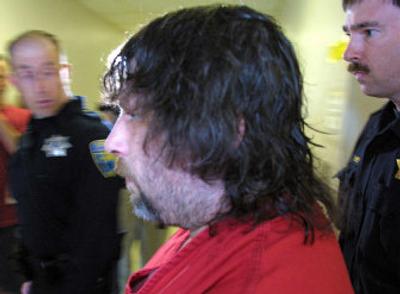
PORT ORCHARD, Wash. – People who saw a flabby, unkempt auto mechanic named Wayne Hower shoot a well-liked convenience store owner last summer told police the gunman looked crazy: He was muttering to himself and shaking, and in his eyes they saw a blank stare.
Since then, three psychiatric experts – one retained by Hower’s lawyers, two by the state – have opined that Hower, who has struggled with violent paranoid delusions for a decade, could not appreciate what he was doing when he shot Al Kono.
That didn’t satisfy Kitsap County Prosecutor Russ Hauge, who does not want to see Hower acquitted by reason of insanity. He hired Park Dietz, a $600-an-hour forensic psychiatrist best known for his findings that cannibal Jeffrey Dahmer, would-be presidential assassin John Hinckley Jr. and many other notorious killers were not legally insane.
Lawyers say the case is interesting first because two experts at Western State Hospital supported Hower’s insanity plea. That rarely happens because Washington has a relatively high bar for such a finding. There are only a few insanity pleas in the state each year.
But this case is even rarer because of Hauge’s decision to seek another opinion, at a cost of many thousands of dollars, in hopes of rebutting the state’s own experts. Dietz’s report on Hower is expected this week, and a Kitsap County Superior Court judge has scheduled a hearing for Jan. 30 on whether to acquit Hower for insanity.
“The legal definition of insanity in Washington is a standard that Mr. Hower does not meet,” Hauge said recently. “He may have a mental disease, but his mental disease on the date in question did not rise to the level of legal insanity.”
In Washington, defendants may be found not guilty by reason of insanity if they could not appreciate the quality of their actions or tell right from wrong at the time of the crime. That standard is known as the McNaughton rule. It dates to the mid-19th century and is considered archaic by many psychiatric experts. Seventeen states use the more forgiving standard of whether a defendant was “substantially impaired” by a mental condition at the time, and some others consider whether the defendant suffered from an “irresistible impulse,” even if he or she could tell right from wrong.
Hospital commitment
Those acquitted by reason of insanity in Washington are committed to a state hospital for up to the maximum term had they been convicted. In Hower’s case, that’s life for aggravated first-degree murder. But patients are typically released sooner if the hospital determines they are no longer dangerous.
Hower, a 44-year-old divorced father of two grown children, has been treated for paranoid delusions since 1994, when he was involuntarily committed to Kitsap Mental Health Services after having a breakdown. He believed aliens were sending him messages and that people were monitoring him through his television set, and he heard voices, said one of his lawyers, David LaCross.
The victim was an acquaintance. Kono, a married father, ran PJ’s Market on a road into Port Orchard, a small blue-collar town on the Kitsap Peninsula. Hower was a regular; Kono let him run a tab. On June 23, Hower parked his car in front of the store. He went in twice, once to get cigarettes and again to get matches. Both times, he returned to the car. When Kono came out, Hower walked up and shot him, making no effort to conceal his identity before the regular patrons chatting there. Hower calmly walked back to his car and drove home. One witness followed him and told police where he parked. When officers arrested him, he asked to speak with a lawyer – potentially the only sign he may have known he’d done something wrong, though he said he simply didn’t want to discuss his theory of the universe with police.
A week later, the defense hired $300-an-hour Pogos Voskanian, of the American Board of Psychiatry and Neurology, to review his clinical records and evaluate him. Voskanian said Hower had a clear case of paranoid schizophrenia, potentially accompanied by Capgras Syndrome, in which he believed there were multiple copies of the universe. He believed Kono was controlling various aspects of the universe, and that Kono would continue to exist if one of his copies was destroyed.
At the request of the prosecutor’s office, Hower was then evaluated by a sanity commission, comprising a psychologist and a psychiatrist, at Western State. “At the time of the incident, Mr. Hower’s mental disorder was of such proportion as to constitute a mental disease or defect that grossly impaired his perception of reality, to the point that he was unable to know the nature and quality of his acts or to know that his acts were against the law,” the commission concluded.