
Nature’s course
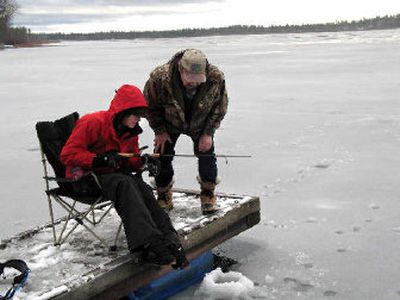
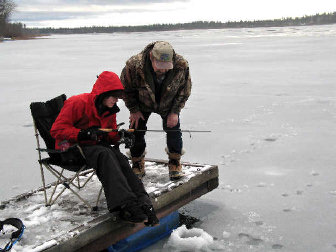
At the very least, the mixed group of high school students on a fishing field trip to Eloika Lake last week got a good lesson in the three P’s — perseverance, patience and peeing in the woods.
Dolling out maggots and getting cold, wet and dirty was all in a days work for Robin Crain, soccer coach and outdoor living teacher at Ferris High School.
And half a dozen volunteers from the Inland Northwest Wildlife Council mentored the students in a selfless one-on-one style they’ve perfected over the decades on their buddies, neighbors and children.
“We get paid every time we do this, but I’m not talking about money,” said council volunteer Tom Fisher as he looked through the gloom at the cheery group of teenagers. “I just wish we had a better day for them to get out on the ice and catch fish.”
Nasty weather conditions prevailed on the day they were scheduled to go winter fishing. Rain and wind had left pools of water and slush on the ice capping the lake. For safety’s sake, the students were grounded to the dock at Jerry’s Landing.
At the end of the day, the total catch was minimal for all the effort and several thousand calories consumed in typical teenager energy food, such as Cheez-its. The final tally: three perch, two red-ear sunfish and one grass pickerel.
“We can learn about ice fishing and being out in the elements even if we don’t catch many fish,” Crain said, noting that a couple dozen students made the trip. “We have about 80 outdoor students total in three classes. The weather scared a lot of them off. But these are the cream of the crop. They don’t mind the conditions. I pointed out the terrible weather at school before we left school this morning, but not one of them suggested we bag the trip.”
Michelle Moss, a junior, had done her homework. She came prepared with a hooded parka, rain pants, boots and a camp chair with holders in the armrests to keep her Thermos of hot tea handy as she perched over her hole in the ice.
“She gets an A today,” one boy said.
Learning to build survival shelters was among her favorite first-semester lessons in the class, Moss said, adding, “If worse came to worst, I probably could survive.”
Vactor Bezmen, another junior, said his favorite outdoor session was learning to build a fire in wet, snowy conditions. “For the test, each group got just one match,” he said. “My group failed. But we got a fire going on our second chance.”
Ben Read said he had already learned most of these basic outdoor skills before enrolling in the elective class for his senior year. With a little prodding, he revealed that he’s an Eagle Scout. “A lot of this is just review, but I can’t think of a more enjoyable class,” he said. “And there’s always something new to learn. I’ve never been ice fishing.”
Ditto, said two former outdoor living class students who graduated last year.
“We asked Mr. Crain if we could come along since our ice fishing day never happened last year — there was no ice,” said Jeremy Schuiteman, who was sharing a hole in the ice with his fellow graduate Mike Keane.
The course isn’t all outdoor fun and games, Crain said. “We have learning targets, a lot of hands-on activities based on science and work that increases reading skills.”
Before building survival shelters, the students learn about body temperature and hypothermia, he said. Then each student is asked to go home and assemble a survival kit that will fit in a pint can.
“I don’t give them a lot of rules and they do some great original thinking,” he said. “One kid mixed sawdust with wax and melted it into a Dixie cup for fire starter. They get to keep the kits and hopefully they’ll go in to their family vehicles where they might be useful sometime.”
Crain particularly enjoys teaching the autumn unit on edible and poisonous plants.
“They learn to use a field guidebook and how to key out plants they gather and press,” he said. “Then they get into groups to come up with recipes for using edible plants in a class cook-off.”
Last fall’s cook-off favorites were as mainstream as crabapple sauce and elderberry muffins ranging to creative taste treats such as lemonade made with the furry berries of staghorn sumac, pink pasta made with dried and ground rose hips, pineapple weed tea, sautéed Russian thistle tips, chickweed pancakes, nutritious salads from wild greens and mallow grass stew.
The worst dish of the semester: “The cattail smoothies were absolutely disgusting,” Crain admitted, hinting at one of his occupational hazards.