
Whale in Thames River dies during rescue try
LONDON – The bottlenose whale spotted swimming past the Houses of Parliament and Big Ben captivated thousands with its appearance in the River Thames. The death of the ailing animal, wounded and swaddled in blankets, brought a sad end to the saga of London’s most unlikely tourist.
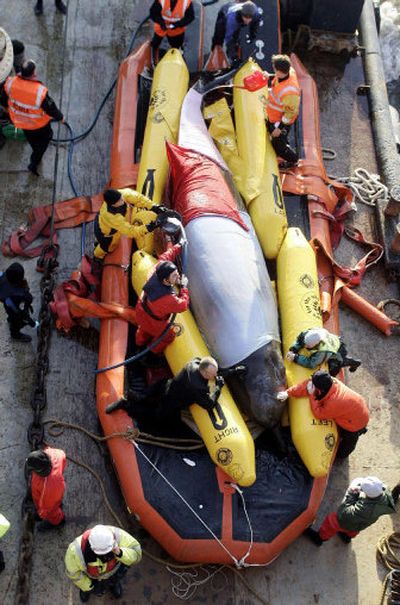
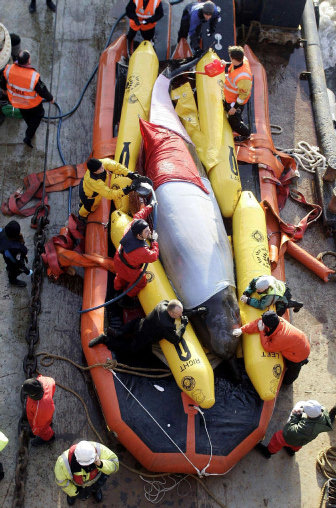
About 3,000 people lined a stretch of the Thames on Saturday, cheering as marine wildlife experts used a crane to haul the 20-foot-long whale onto a rusting salvage barge.
The rescue crew then faced a race against time to reach deeper waters on England’s southern coast – as the whale’s internal organs suffered the crippling effects of being out of the water. En route, the mammal suffered a series of convulsions and died.
“It was a brave, valiant, but ultimately tragic effort to get the whale to safety,” said Leila Sadler, scientific officer at the Royal Society for the Prevention of Cruelty to Animals.
City workers had watched in disbelief Friday as the marine mammal was spotted flailing through the murky river, past some of the city’s most famous landmarks. It was the first Northern bottlenose whale spotted in the Thames since records began in 1913.
“The animal suffered a series of convulsions about 7 p.m. and died. It was already dehydrated, hadn’t been feeding and the being out of the water would have, in effect, shriveled the animal’s internal organs,” Sadler said.
“It was essential to try to take the whale out to sea on the barge – but there was always the risk this would happen.”
Rescue crews were heading toward Margate, on the southern English coast, where they hoped to let the whale back out to sea, when a veterinarian confirmed the death.
“There was a real chance that the rescue attempt could have succeeded, but these type of mammals are very prone to the effects of stress and I’m afraid it all became too much,” said Tony Woodley, spokesman for the British Divers Marine Life Rescue group, which led the rescue attempt.
A veterinarian will conduct a necropsy aboard the salvage vessel to determine the cause of death.
“All the crew on the barge are shattered by the death,” Woodley said. “They were tired and exhausted but had been determined to do everything they could to get the whale to safety. It really is a terrible shame.”
Experts had warned earlier that the whale, normally found in the cold North Atlantic, may not survive. Witnesses said the mammal’s snout was bloodied, and photos appeared to show damage to one of its eyes and a number of cuts on its torso.
International and local television networks broadcast the drama live, with the RSPCA estimating 23 million people saw the events unfold on television across the globe. At the scene, police were forced to close a nearby bridge as the number of people watching swelled.
Whales are known as curious animals, readily approaching boats and normally traveling in groups, according to the Whale and Dolphin Conservation Society’s Web site.
Mark Simmonds, science director at the society, said that whales swim away from their pod and become disoriented when sick, old or injured. However, some witnesses reported seeing a second whale in a different section of the river Friday, suggesting a pod may have been nearby.