
Palestinian vote being observed closely
GAZA CITY, Gaza Strip – The Palestinians’ parliamentary elections today could alter the course of Middle East peace efforts and give a powerful new political voice to the Islamist group Hamas.
The balloting, representing an unprecedented challenge to the decade-long dominance of the ruling Fatah movement, is being closely watched by Israel and the Bush administration. Both have expressed strong concern over the likelihood that Hamas, known for its long and bloody campaign of suicide bombings against Israel, will win a significant share of legislative seats.
Nearly 1.4 million Palestinians in the West Bank and Gaza Strip were eligible to vote, and turnout was expected to be high. More than 900 international election observers, including former President Carter, were on hand to monitor the vote. They will be scrutinizing in particular the Palestinians’ ability to get through Israeli checkpoints and reach polling places.
Amid fears of violence, tens of thousands of Palestinian police fanned out to watch over the balloting. On the eve of the election, gunmen claiming allegiance to an offshoot of the ruling Fatah movement shot and killed a party rival in the volatile West Bank town of Nablus.
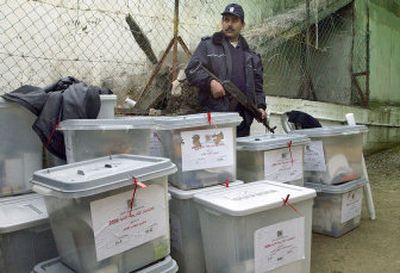
Tensions also were high in the Gaza Strip, where armed men have in past months staged dozens of attacks on government buildings and election offices. Police in camouflage-blue uniforms, toting automatic weapons, patrolled Gaza City’s rundown streets in small groups.
Seven major Palestinian militant groups, including Hamas, vowed Tuesday to help maintain calm on election day. But the smaller Islamic Jihad refused to join in that pledge and pressed ahead with calls to boycott the vote.
Palestinian Authority President Mahmoud Abbas of Fatah, voted into office just over a year ago, has repeatedly promised that security forces would “strike with an iron fist” against anyone trying to disrupt the vote with violence.
Israel placed its own forces on high alert but ordered troops to keep as low a profile as possible. The military reportedly planned to refrain from arrest raids in Palestinian cities and towns except in the case of so-called “ticking bombs,” those thought to be planning imminent attacks.
However, Israel rounded up more than two dozen suspected Palestinian militants in the two days before the election, including raids that continued into the predawn hours Tuesday.
As public opinion polls suggested that Hamas would pick up at least one-third of the vote, both the Islamist group and its main rival, the ruling Fatah faction, spoke of the possibility of forming a coalition. But because Hamas’ charter calls for the destruction of Israel, any such alliance would be fraught with complications.
Today’s vote marks Hamas’ first participation in a parliamentary election. The group boycotted the Palestinians’ sole previous such vote, held in 1996, because of its bitter opposition to the 1993 Oslo interim peace accords under whose auspices the Palestinian Authority was created.
While Israel and the United States regard Hamas as first and foremost a terrorist organization, many Palestinians admire the Islamist group’s charity work and its image of incorruptibility – the latter a stark contrast to the graft-ridden Palestinian Authority.
“We trust Hamas to do what is right,” said 74-year-old Mahmoud Jaabari, who leaned heavily on a cane as he hobbled along a Gaza City street. “Their hands are clean.”
Hamas has indicated that even if it were to win the largest share of seats, it would seek only lower-level Cabinet posts that would involve overseeing social programs – an area in which it has built much of its popularity and prestige.
However, even left-leaning Israeli politicians such as former Prime Minister Shimon Peres say Hamas must disarm and renounce violence before Israel could even consider having any dealings with it.
Voters are electing 132 lawmakers to serve in the body formally known as the Palestinian Legislative Council. Under the late leader Yasser Arafat, the parliament was largely a rubber-stamp body, but in the 14 months since his death, it has grown somewhat more assertive.
Half of the lawmakers will be picked from the national slates of 11 parties contesting the election, and the other half from balloting in the districts where the candidates live.