
Adding donkey to mix offers new lessons
We emptied and sold our city house, saying goodbye to our beloved garden.
When the dust finally cleared, our life on the edge of a small town was waiting to be built. One obvious advantage: There is more space out here for animals!
A flock of chickens and stray cats, then Rita, the senior quarter horse mare, moved in.
Driven by the dream of pleasant rides under the summer sun, I spent our first days building shelters and fencing, moving hay and learning to work my middle-aged body.
Did the people who developed over-the-counter pain meds get enough credit?
A couple of weeks later something clicked in the normally calm Rita. She began, like those poor crazy bears in the zoo, to pace endlessly.
In days she walked away hundreds of pounds, validating weight-loss infomercials and causing me untold worry.
She walked and walked, treading a deep ditch in the field along the fence (which filled with rain and behaved like a swamp) seriously tarnishing my country fantasies.
Experts said, “Get her a companion – soon.”
In time Tumbleweed would arrive to befriend the intensely lonely Rita, but first we hosted a series of borrowed horses.
Rita’s perpetual motion stopped but the hay bale vanishing act began. Really good hay is worth its weight in gold.
A genuine greenhorn, I had not calculated hay reserves for two horses, just Rita. Rita and transient friends were (optimistically) to thrive on the abundant pasture grass.
The hay would be “back up” rations.
A month later the lush pasture was bare and the hay was seriously dwindling. I desperately needed to decrease my equine guest list.
A very small, tiny even, hay burner would be best. Perhaps a goat?
They say a goat and horse may get along fine. They also say goats will hop a mile and squeeze through fence holes no larger than the eye of a needle.
Honestly, life is complicated enough. Setting aside hastily entertained fantasies of my very own artisan goat cheese operation, I shifted my focus to a pony.
I considered a couple, but the looks in their eye made me uneasy. Then came Tumbleweed.
I found her while reading the “For Sale” board outside a store.
A fellow greenhorn (cutting down on hay burners) was offering an affordable donkey.
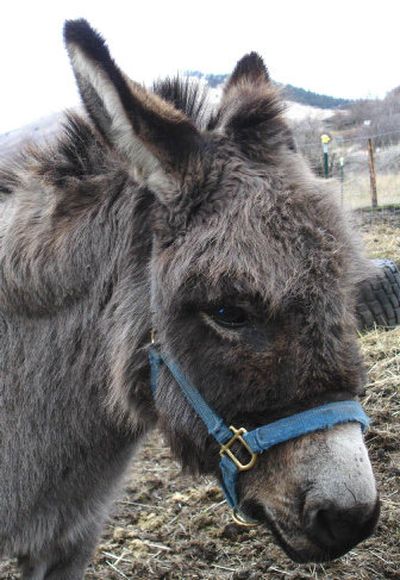
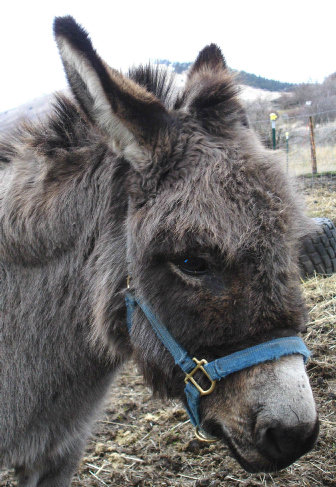
After brief discussion with my wife and precious little planning, I retrieved one very chubby miniature jenny (girl) donkey, stepping into the donkey learning curve.
What’s to learn?
Lesson No. 1: You can lead a donkey to water, but you absolutely cannot make her drink.
Tumble enjoys a warm drink on cold days and ignores the spring water in her pasture. Warm water must be delivered morning and night.
I carry the water down a precariously snowy hill in 5-gallon buckets. Steam swirls overhead as she silently partakes.
I wonder if she may require ice cubes come summer?
Lesson No. 2: Donkeys are very loud.
She greets the dawn with inhaled warm-up squeaks (like a huge door opening) followed by the massive exhale fog horn part.
When she greets me in person, I say, “Good Lord, Tumbleweed” loudly, hoping to forgo a second greeting.
Lesson No. 3: She likes to lead.
If determination could be weighed, Tumble would be a heavyweight. When my chosen direction is not right for her, she weighs a ton.
Like a martial arts master, she silently sends her “energy” down to the center of the earth, rooting like an oak tree.
Though I pull ahead on her lead rope, there is no movement. When I change our course even slightly, it encourages her to move, which suggests she’s taking a stand based mostly on principle.
Though our zigzag progress is very slow, it’s fine with me.
I am not in a hurry these days, and besides, everyone can use a friend who won’t be pushed (or pulled) around.