
Defending trees
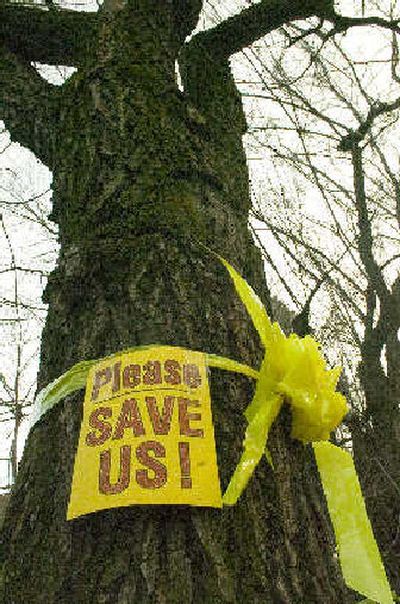

Residents’ e-mails and yellow ribbons tied to dormant trees on Bernard Street may have caught the city’s attention. But the efforts didn’t change the decision to remove 22 trees for the Bernard Street reconstruction project. After consulting with the city’s arborist, the city has determined it will have to remove the trees, Mayor Dennis Hession said in a news release Tuesday.
“Street trees are great assets in our neighborhoods, and we’ve struggled with the decision to remove these trees,” Hession said. “We certainly appreciate all the input we’ve received from neighbors and other citizens, but in the long run, this is the right decision.”
Richard Rush, an urban landscape activist and member of the Cliff-Cannon Neighborhood Council, and others who tried to dissuade the city are disappointed.
“He is just repeating the line that the city engineer has been delivering to neighborhood the last two months,” Rush said.
“If we let every little bump in the road distract us from our vision of a walkable community with street trees, can we ever honestly say that Spokane is ‘Near nature. Near perfect’?” asked Rush, referring to the city’s slogan.
Last fall, the city announced plans for a $4 million street reconstruction to improve about two miles of Freya Street from Hartson to 37th avenues and about a one-mile stretch on Bernard. The project is part of the city’s street bond program, a 10-year plan to repair 110 miles of streets.
The first reconstruction project involves removing about five trees and relocating 42 utility poles on Freya. Residents there haven’t been nearly as vocal as those in the Bernard Street neighborhoods, who had planned a candlelight vigil Wednesday night to protest the decision.
Chris Davis, a lifelong South Hill resident, criticized the city’s planning process.
“I’m really surprised there was no collaboration with the community,” said Davis, a member of the Comstock Neighborhood Council. “We were told what they are doing and that’s that. I’m really appalled.”
The city did, in fact, hold several meetings over the past several months where city officials and Avista Utilities representatives outlined the reconstruction projects.
Davis said he attended a meeting at Wilson Elementary School where the question was presented, “Do you want new streets and new trees or old streets and old trees?”
“And they took that decision away from us.” Davis, an architect, said.
The city plans to start working on Freya in May and on Bernard in June. Each project, to be done in phases, is expected to take about two months.
Four utility poles alongside Bernard also will need to be relocated. The city said from the start it is offering homeowners’ replacement trees, an offer reiterated by Hession on Tuesday.
However, the new trees will not be planted on bumper strips – the grassy area between the curb and the sidewalk – but instead on lawns. The homeowners have been told their sycamores, elms and maple trees, some up to 10 feet in circumference, have caused sidewalks to buckle or do not comply with the clear zone policy, which dictates the distance between the curb and the tree. They were also told that the trees were unhealthy.
Davis said the trees have been improperly pruned over the years, which has damaged them. After the ice storm in 1996, “Avista went around and cut back everything,” he said.
The city said the work was a safety issue.
“Clearly some of those trees have been topped to reduce proximity to the power lines so they are not safety problems,” said Marlene Feist, public affairs officer for the city of Spokane.
Feist said a number of sick trees along Bernard Street were going to be removed by Avista in the near future but the city asked the utility company to wait until the reconstruction program begins.
The Bernard Street project prompted more than 150 people to send e-mails to Hession, the City Council and the Citizens’ Streets Advisory Commission, expressing their disapproval.
Last Saturday, 16 adults and three children hung yellow ribbons and signs on the trees that are ticketed for firewood.
Some attached “Help Save Us!” signs to the trees.
Suzanne Markham and her husband, Paul Markham, organized the activity. The couple live on South Manito Boulevard and are selling a house closer to Bernard.
“We’re disappointed with the press release, and other solutions are not being pursued,” Suzanne Markham said. “You don’t replant something that looks like an 80-year-old tree.
“This situation exists all over the city, and it sets a terrible precedent and puts a lot of trees all over the city in jeopardy.”
The e-mail plea was highlighted by a 682-word letter drafted by Rush, an eight-year resident of the Manito neighborhood. Aside from the obvious – that fewer trees would detract from the South Hill’s beauty – Rush and other objectors claim the city is not in compliance with the Comprehensive Plan of 2001.
The plan is aimed at making Spokane more pedestrian friendly, with an emphasis on more “meaningful transportation options.” Rush’s letter told of the Olmstead Brothers’ view of Spokane, “when streets were designed with generous pedestrian buffer strips and street trees that grew to become majestic, continued and expanded.”
He said the reconstruction plan does the opposite in some cases, removing existing street trees and planting others elsewhere in the neighborhood.
Rush and Bonnie Mager, director of the Spokane Neighborhood Alliance, suggested extending the bumper strip, perhaps by making Bernard eight feet narrower. Another suggestion was to reconstruct sidewalks around the massive trees, which some homeowners have done themselves.
The city’s response was the street bond program was set up to pay only for the rehabilitation or restoration of streets, not redesigning them. Hession said he realized the passion people have about the trees, but the city plans to “create an environment where those trees grow back in a healthy way.”
He added that the city is in the middle of working on a new sidewalk local improvement district program, and “in a few years we will have provided a much better product and people will be excited.”