
President speaks on Abramoff
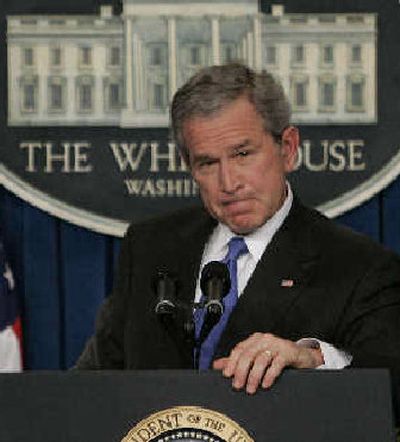

WASHINGTON – President Bush tried to distance himself Thursday from disgraced lobbyist Jack Abramoff while refusing to release White House pictures taken of him with Abramoff.
“I, frankly, don’t even remember having my picture taken with the guy. I don’t know him,” Bush said. “But I can’t say I didn’t ever meet him.”
The president’s remarks came during a wide-ranging, impromptu White House news conference in which he continued to defend his domestic spying program, embraced a Russian proposal to end the stalemate over Iran’s nuclear activities and carefully interpreted a militant Islamic group’s stunning victory Wednesday in Palestinian parliamentary elections.
Bush’s recollection of Abramoff was fuzzy, but the high-flying lobbyist was well known in political fundraising circles, including the Bush-Cheney campaign, which received a $6,000 contribution from him. The campaign donated the money to the American Heart Association earlier this month after Abramoff pleaded guilty to fraud charges and agreed to help federal prosecutors in their investigation of possible corruption in Congress and the White House.
Since Abramoff’s plea, administration officials have acknowledged that he met with some White House staffers but won’t say whom or about what. White House press secretary Scott McClellan has said Abramoff was in the White House at least twice for Hanukkah parties, where he may have had pictures taken with Bush.
Administration officials want to keep any Bush-Abramoff pictures from becoming public to avoid giving political opponents ammunition that could hurt Republicans in November’s congressional elections.
“Having my picture taken with someone doesn’t mean that I’m a friend with them or know them very well. I’ve had my picture taken with you at holiday parties,” the president reminded reporters. He estimated that he’d posed for about 9,000 photos at receptions this past holiday season alone.
“I’m also mindful that we live in a world in which those pictures will be used for pure political purposes, and they’re not relevant to the investigation,” Bush said.
Regarding the spying program, the president reiterated his contention that he was within his constitutional rights to authorize electronic eavesdropping without getting a warrant from a court or specific approval from Congress.
Bush’s critics charge that he violated the 1978 Federal Intelligence Surveillance Act, which requires warrants from a secret U.S. court for such eavesdropping.
“We’re having this discussion in 2006. It’s a different world,” the president said.
Turning his attention to the Middle East, Bush called Hamas’ surprising victory in Palestinian elections a “wake-up call” to Palestinian leaders who followed the late Yasser Arafat. “Obviously, people were not happy with the status quo. The people are demanding honest government. The people want services.”
On Iran, the president called a proposal by Russia to enrich Iran’s uranium and return it to the Islamic nation for use in fueling nuclear reactors for electricity “a good plan.” Iran maintains that it wants nuclear-powered electricity, but the United States and the European Union fear that it’s pursuing nuclear weapons.