
Gay rights bill passes
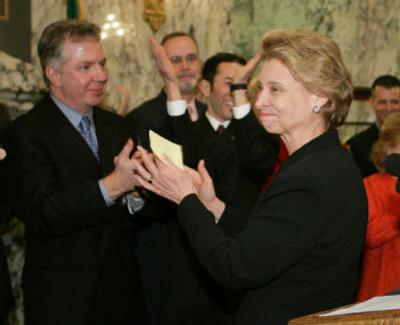
OLYMPIA – Cheers broke out in the packed public galleries of the state Senate as lawmakers – after 29 years of trying – approved a bill to make it illegal to discriminate on the basis of sexual orientation.
“This is a great day, a great day,” a jubilant Gov. Chris Gregoire told supporters Friday minutes after the bill cleared both the Senate and House of Representatives. Gregoire vowed to sign the bill into law on Tuesday morning. It bans discrimination in employment, housing and financial dealings.
The largely Democrat-backed bill got a critical boost this year when the Senate’s former top Republican, Sen. Bill Finkbeiner, said he’d had a change of heart and would vote “yes.” Last year the measure failed in the Senate by one vote. “What this debate is about is whether or not it’s OK to be gay,” Finkbeiner told lawmakers. He said he felt that it’s fundamentally wrong to allow discrimination against gays and lesbians “because of who their heart chooses to love.”
The bill was strongly opposed by many Republicans, particularly in the Senate. Some argued that homosexuality is morally wrong. Some predicted that the bill paves the way for a court ruling allowing same-sex marriage.
“We, the state, are telling people to accept – actually to embrace – something that goes directly against their religious views,” said Sen. Dan Swecker, R-Rochester. “When the heavy hand of government buckles the rights of free speech and free association, we all lose.”
“Is it fair for the state to label one person’s morality as illegal bigotry?” asked Sen. Brad Benson, R-Spokane.
Proponents, trying to assuage critics’ concerns over same-sex marriage, have repeatedly denied that the bill would affect marriage statutes. It may not matter. In an unrelated case, the state Supreme Court is set to rule on whether the state’s ban on same-sex marriage is constitutional.
“I believe they’re going to rule to give us marriage equality,” said bill sponsor Rep. Ed Murray, D-Seattle, standing beside his longtime partner, Spokane native Michael Shiosaki. “And if the court doesn’t do it, I’ve got a marriage bill that’s sitting on my desk. It’s written. It’s ready to go.”
Friday’s vote may not be the last round in the fight over the anti-discrimination bill, people on both sides say. Murray predicted that foes will try to veto House Bill 2661 with a statewide referendum in November.
“It’s so easy to put anything on the ballot these days that we expect one,” Murray said. “We’re ready.” Gregoire also vowed to fight any such measure.
Bothell pastor Joe Fuiten, chairman of the evangelical group Faith and Freedom Network, said it’s likely that someone will file a referendum. His group, which opposed the bill, said Friday that it’s organizing pastors “to prepare for the next round.”
“I would give it a 70 percent chance at this moment,” Fuiten said. “What happened in Spokane on this measure is the one thing that gives me pause. You don’t want to have a referendum and lose.”
What happened in Spokane is that in 1999 the City Council passed an anti-discrimination ordinance very similar to the one lawmakers approved Friday. Critics promptly mounted a repeal effort, but in a citywide vote the law was upheld.
In Olympia, the debate over the anti-discrimination bill this year has been unusually personal, with lawmakers on both sides of the issue talking about friends and family members who are gay and lesbian.
Senate Majority Leader Lisa Brown, D-Spokane, sat in the gallery with her lesbian sister one day, watching the House debate the measure. Rep. Fred Jarrett, R-Mercer Island, proudly introduced his daughter and her lesbian partner at a gay-rights rally on the Capitol steps on Monday.
On the other side of the issue was Sen. Bob Oke, who said that he’s spent a lot of sleepless nights recently, fretting over how to vote on the bill. Oke, who is deeply religious, has a lesbian daughter. He showed lawmakers a photograph of her as he spoke, but shielded the picture from news cameras.
“I believe homosexuality is morally wrong,” Oke said, calling it “an abomination.” His daughter, he said, “has chosen the life,” a fact that greatly pains Oke and his wife. He described how he had refused to let her visit the family home with her partner and called it “tough love.”
“I wish no harm to people who have lost their way in God’s eyes,” Oke said. “I feel this bill will greatly hinder their journey to the truth.”
Sen. Brian Weinstein, D-Mercer Island, predicted that lawmakers who voted against the bill would “be judged very harshly by future generations. Your sexual orientation is a sin? Your identity? God would not make it a sin to be who you are.”
Benson said bigotry is clearly wrong, but the legislation is “unnecessary, unwise and creates uncertainty.” Gays and lesbians, on average, are better educated, with better cars, better houses and higher incomes than heterosexuals, he said. He predicted that the bill would open a Pandora’s box of legal problems.
Brown’s response: In the six years that Spokane’s had such a law, there’s been no wave of problems. There have been eight complaints, most involving “hateful communication” or property damage, she said.
“It just doesn’t wash that horrible things are going to happen when we pass this bill,” she said.
As for gays and lesbians being well-off, she said, “Yes, some have very nice houses on the South Hill of Spokane. But some open their door, and they look out on the Palouse. And some, sadly, are homeless.”
Brown, along with fellow Democrats Reps. Timm Ormsby and Alex Wood, both D-Spokane, were the only local lawmakers to vote for the bill. Sen. Bob McCaslin, R-Spokane Valley, was excused from the Senate vote. He was in Spokane having a long-scheduled bone scan for a hip and back problem. “I was a ‘no’ vote,” he said by phone.
Brown said after the vote that she’s encouraged by what she heard while driving her 13-year-old son around with a friend recently. The two were discussing the anti-discrimination measure, she said.
“They said they just don’t see what all the fuss is about,” Brown said. “That gives me a lot of hope for the future of the state.”