
Chaos disrupts Saddam trial
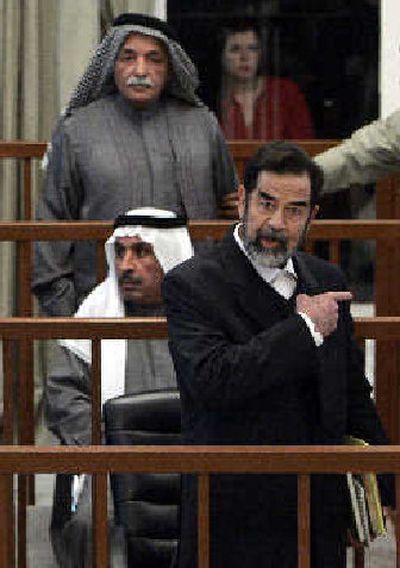
BAGHDAD, Iraq – A bench-clearing brawl and angry tirades marked the return of Saddam Hussein to the defendant’s dock Sunday, as a new chief judge proved incapable of stopping the mayhem that has dominated the trial of Iraq’s deposed dictator.
The session, the first in a month, was the most rancorous yet in an already turbulent trial. Barzan Ibrahim Tikriti, a co-defendant and Saddam Hussein’s half brother, was dragged out fighting with bailiffs after he swore at the court. Defense lawyers walked out in protest, saying the trial was unfair, and Saddam was escorted from the room after a shouting match with Chief Judge Raouf Rasheed Abdel-Rahman, who declared he would no longer tolerate such behavior.
Abdel-Rahman appointed new defense lawyers and resumed the trial with the remaining six co-defendants, who are accused of killing more than 140 people in retaliation for an assassination attempt against Saddam in 1982. The court heard testimony from three witnesses, and after five hours the trial adjourned until Wednesday.
The courtroom chaos left the trial a shambles. International observers had already questioned the fairness of a trial that has witnessed the assassination of two defense lawyers and the departure of three of the original five judges on the tribunal. Now it is unclear whether Saddam and his defense lawyers will return to the next court session.
A trial official said the lawyers would have to ask to be readmitted and that Saddam might be compelled to come against his wishes.
“The court controls the session; it is not according to Saddam’s will,” said the trial official, who spoke on the condition he not be named. “Everything is going according to law.”
The head of Saddam’s defense team demanded that the trial be moved abroad.
“In view of the biased policies adopted by the court’s chief judge to push for a quick conviction, we are demanding that the trial be moved outside Iraq to put an end to this farce,” Khalil Dulaimi, Saddam’s lawyer, told the Reuters news service.
Abdel-Rahman, who replaced Judge Rizgar Mohammed Amin after the latter resigned, made it clear at the outset of the trial that he would not tolerate the political speeches and insults that have frequently interrupted the trial since it opened in October.
“Political speeches outside the scope are for outside the court,” Abdel-Rahman said. “Any speeches outside the scope will be deleted from the minutes of the court. Any defendant who violates the law will be taken outside the courtroom and be tried according to the law.”
As in the past, the courtroom theatrics overshadowed the testimony of the three witnesses against Saddam, who, like their predecessors, described suffering brutal punishments at the hands of the dictator’s government.
One witness, a woman who spoke while concealed behind a curtain, said she and her family had been imprisoned for four years after the assassination attempt. After enduring electric shock torture at the police station, she said they spent 11 months in Abu Ghraib prison, where they were frequently put into solitary cells.
“When the baby cried, he took it and put it in the solitary cell,” she said. “It was 2 years old. The food and treatment was beyond description.”